Sunday, June 11, 2017

Discomfort and Discourse: Myths of 18th Century Women’s Fashion Part 2

by Danielle Funiciello

In March, we dove into some myths about women’s fashion with an article about what was and wasn’t considered scandalous dress in the 18th-century. Today we will be continuing that thread with some myths about the ‘corset’ or, more accurately, ‘stays’. I will not be covering the terminology shifts in this article, but within the 18th-century, ‘corsets’ were actually a soft garment quite the opposite of the rigid stays that we have come to think of as corsets (if you want more on the distinctions and history of the terminology this fascinating blog by The Dreamstress should do the trick). For the rest of the article, we will be using the 18th-century terms; ‘stays’, ‘pair of stays’, or ‘pair of bodies’. Whatever the terminology, I have never done a program in historic clothing where someone has not wanted to know about my underthings. The questions and assumptions about these garments are almost always the same, so without further ado;

The Myths: Stays are uncomfortable torture devices that make it impractical to do work or breathe properly and caused women to faint frequently. Women needed to be laced into their stays by a servant or their husband. Historically, men used stays to subjugate women, as a way to keep women as the fragile, weaker sex by limiting their movement and preventing them from doing work.


For Disney fans, the arguments may sound familiar. Emma Watson had strong feelings about wearing ‘corsets’ as Belle in the March-released live-action remake of Beauty and the Beast. Her concerns were based in feminism and the idea that stays restricted women and made them incapable of action (if you are not a Disney fan, just Google ‘Emma Watson corset’ to see the dozens of articles surrounding her decision not to wear structure garments). The film is slated as a fantasy setting, so delving too deep into the “accuracy” of various costume pieces would be unproductive, but it is worth pointing out that the majority of costuming fits into the late 18th-century and, as we shall discuss today, stays had different fits, purpose, and societal meaning within the 18th-century than they do today.

The author in full 18th-
century kit, with stays
underneath.
Let us first address something from personal experiences (my own and those of other female reenactors I have spoken to); worn properly, stays are not uncomfortable. Or, more accurately, stays are not much less comfortable than modern support garments. Like modern support garments, the intent was two-fold – as the name suggests, they offer support, and they create the ideal female shape as prescribed by the culture of their time. That shape was much different from what we consider attractive today – a stiff, conically shaped torso which gave contrast to the soft swell of the bosom and tapered down to jut out at the hips with the help of wide skirts, padding, or paniers.
Also like modern support garments, there are trade-offs to the structure offered. Stays support the lower back and create good posture. However, they can cause chafing depending on the fit and the quality of the shift - the linen underdress worn beneath the stays. For us modern folk who are not used to wearing stays, the posture created also uses muscles we are not accustomed to using, which can ache on new or infrequent wearers.

Talk to many female reenactors and they will tell you; sitting for long periods of time is more problematic than standing, dancing, or performing labor. With these latter actions, properly worn stays can act as a back brace and make labor or movement more comfortable over the course of a day. Few describe breathing problems or fainting spells, even amongst reenactors who wear stays on a daily basis.

As for getting into stays? Believe it or not, getting out of stays by yourself is typically more difficult than getting into them (think getting stuck with an XXS t-shirt halfway over your head!). No servants or husbands required here - at least, with 18th-century stays. There are two key factors that make this a one-woman job in the 18th-century. The first is that stays did not exclusively lace up the back. In the mid-1700s in particular, many stays laced front and back to accommodate a fashion called a stomacher. This would allow a woman to easily lace herself up from the front. The second factor is the way the lacing was done – cross-lacing, as is commonly seen on modern corsets, was not the preferred style of the time and as this lacing how-to on the Hand Bound blog says: “seems to be reserved for lace-up bodices only, as you often see it in images of working class girls”. In other words, cross-lacing was only used, if at all, when it was at the front of a garment where a woman could see what she was doing. For most stays, straight-lacing, also called spiral-lacing, was used. 
Corset lacing, or cross-lacing, shown left, is what you may be familiar with from corsets after the mid 19th-century. Spiral or straight-lacing, much more common in the 18th-century is shown on the right.*
Compared to cross-lacing, straight-lacing does not create a lot of friction when pulled, and so can pulled from the tail of the lacing, rather than from the hard-to-reach center of the back as one would have to in order to properly cross-lace. Straight-lacing also has the benefit of lying flatter under garments and allowing for more flexibility. In the later 19th-century, cross-lacing was adopted because the friction created prevented the lacing from loosening during tight-lacing (see below) – a particular problem with upperclass garments which used silk lacing.

Children's stays in the collections of
The Metropolitan Museum
Within the 18th-century, many physicians praised stays for their support and the posture they created. There were arguments for the ‘beauty of the human form’ that this created as well, but people within the 18th-century seemed to consider stays, worn properly, to be first a boon to health, and second a fashion item. While the whalebone used in upper-class stays could be cost prohibitive for some, materials like thick reeds could be substituted, which allowed women from all walks of life to wear them for support. They were considered so healthful, that even children – male and female – in wealthier households grew up wearing stays. We’ll come back to this later.

You may have noticed a key mantra in the preceding text; “worn properly”. NOT tight-laced.

Tight-lacing, waist-cinching, or waist-training, as it has become known in modern times, has been practiced as long as these stiff, laced undergarments have existed (since at least the late 1500s). It became particularly popular during the Regency Era (1795-1820), again in the late Victorian Era (1837-1901), and has had a rebirth with celebrities like Kim Kardashian who advertise their use of spanxs and waist-cinchers (often no longer laced) as a way for women to look thinner by wearing their undergarments too tightly.

Rather than allowing a woman the bracing effects intended by stays, tight-laced stays can create all of the issues in our myth – they cut off circulation, make it difficult to move and breath, and create the unrealistic Barbie-doll-like figures oft’ criticized in the modern era.
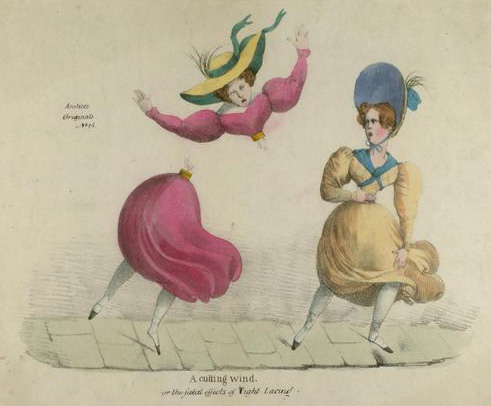
"A cutting wind" shows the perils associated with tight-lacing c. 1820
Within the Schuyler’s lifetime, tight-lacing was practiced by both men and women to create a fashionable figure, but it was also heavily criticized by physicians, satirists and other contemporaries. It was denounced as vain, unhealthy, and dishonest, much as some consider similar practices today. It should therefore be thought of as an extreme fashion, rather than typical use of the garment within the 18th-century. The wealthier one was within that century, the more likely one was to practice tight-lacing. After all, the negative symptoms, particularly the difficulty of movement, were not as much of a strain if one did not have to perform any labor. As one might today wear Spanx™, or even stiletto heels to a party - but not on a walking tour or around one’s house - tight-lacing and other uncomfortable fashions were often reserved for formal and public occasions.

Men's stays from the Bard Graduate Center.
As far as feminist concerns about stays go – while stays were a standard part of women’s dress during the 18th-century, as alluded to earlier in this article, many male children in wealthy families wore stays as well. George Washington, for example, wore stays until he was around 5 years old. These stays were designed to alter the male form into the preferred shape, à la binding practiced by other cultures. In this case, the ideal male form included low sloped shoulders, which gave the illusion of a longer neck, and which was created by lightly binding the ribcage. This in turn pulled the ribs, and thereby the shoulder sockets, down and inward. One can extrapolate that if stays were, to any degree, forced on women because they were known to be unhealthful and cause weakness at
the time, the Washingtons, and other wealthy families, would not have applied such practices to their sons.

"Lacing a Dandy" shows the numerous padding
and garments that could go into sculpting the
fashionable male form, 1819.
As the 1790s progressed into the 1800s, young men of the fashionable set began wearing a male version of stays more regularly. We might now refer to such a garment as a girdle, but the express purpose for these garments was to create the slender wasp-waist that was popular with both men and women. As waists got artificially thinner, criticism of tight-lacing became more prevalent. Health concerns caused by the fashion trend were broadcast by more and more physicians in the 19th-century. In order to discourage men from practicing the trend in the late Regency Period, tight-lacing was often shown as feminine and emasculating. While criticism was also pointed at women, the narrative of it being feminine led to more of a “girls-will-be-girls” attitude when it came to tight-lacing, which in turn led to the stereotypes we forged about stays/corsets throughout the Victorian Era.
"A Dandy fainting or_ An Exquisite in Fits" simultaneously criticizes the negative health consequences of tight-laced garments, and begins to feminize "dandy" fashion trends, including tight-lacing.


Want to learn more about women in the 18th-century, the Schuyler Sisters, and even handle a pair of stays yourself? Check out our Women of Schuyler Mansion Focus Tours. Reservations are required by calling the site. See Facebook for more information.

*Image sources:
https://www.youtube.com/watch?v=B4Y_V5L_wAw
https://passionalcorsets.wordpress.com/lacing-corsets/

Sunday, June 4, 2017

The Corner Chair: Stylish Seating in a Roundabout Way

By Ian Mumpton

The Corner chair displayed in the Study at Schuyler Mansion
Walnut or Mahogany, Green Velvet Upholstery, circa 1765-1775
Touring Schuyler Mansion, visitors have the opportunity to view an impressive collection of 18th century objects and furniture, including a number of items original to the family. One piece that always garners attention is the Corner chair (also referred to as a Roundabout chair) in the Study. Unlike other chairs in the home, the Corner chair has its seat turned 45 degrees to the usual position, coming to a point at the “front”, with the rail and back wrapping around two sides of the square seat. It occupies a central position in the room as soon as you enter, and its unusual shape makes it the frequent object of conversation and questions: “Why does that chair look like that?”, “How would you sit in a chair of that sort?”


What makes this chair so cool is that there is no single answer to these questions. Instead, to explain a Corner chair, you have to look at who is using it when, how they end up using it, and why they are doing so.

Many early-18th century examples of these chairs either feature rounded fronts or indented sides. According to Jenny Pynt and Joy Higgs, authors of A History of Seating,3000 BC to 2000 AD: Function Versus Aesthetics, early Roundabout chairs were designed to encourage good posture while reading and writing. The sitter would sit inclined forward over their reading or writing surface, straddling the forward leg of the chair. This was not possible for women with their long gowns, but for men it allowed them to put their legs slightly back with their knees falling just a little below the level of the chair seat. This resulted in a sitting position that both inclined the sitter forward but maintained a straight back at a roughly 90 degree angle to the lap. According to Pynt and Higgs, less ornate version of these chairs could be found in working homes in the early century as well, especially those of weavers, further indicating the intention to encourage comfortable posture.

Portrait of John Bours in the Worcester Art
Museum
. Bours is seated sideways in a corner chair,
accentuating his refinement
By the mid-to-late 18th century, more angular versions of the chair grew in popularity. Rather than coming to a rounded front over the forward leg, this style of Corner chair, like the one in the Schuyler Mansion study, comes to a right angle with straight edges. This change in style accompanied a change in use, though it is debated whether form followed function or vice versa. Attempting to straddle the forward leg on an angular chair of this sort can be far less comfortable than with its rounded cousins. Instead, by mid-century, it became increasingly common to sit sideways in the chair, reclining along one arms of the chair in a dashing style.


To understand the importance of this change, it is necessary to explore personal display and proper sitting culture of the time. The 18th century concept of refinement held that, just as a genteel person beautified their home with elegant furnishings and filled their lives with intellectual and gentlemanly activities, the way that one presented the body reflected a cultured lifestyle. Proper posture was considered essential to attaining this intangible goal, not only while standing, but while sitting as well.  The easiest way to explore this is through images.

The Wrapping Landlady, reflecting rustic, working-class seating.

The first image, The Wrapping Landlady, dates to the 1750’s. It depicts two people whom, from their clothing alone, we can easily tell occupy a relatively low station in society. To the 18th century eye, posture would be just as clear an indicator of their status. While the landlady herself sits with an upright posture, her folded arms hint at a working-class status. The man is another case altogether. He is leaning back on a bench, his elbow on the table and one leg stretched out along his seat. This is not at all the posture of a gentleman.


The Thistlethwayte Family c.1758 by Thomas Hudson,
in the collection of the Yale Center for British Art
We can contrast this with the Thistlethwayte family portrait, circa 1758. Note the perfectly straight backs of the mother and her daughters, as well as the careful placement of their arms. While the father is not sitting, he is very specifically leaning on the back of the seat occupied by his wife, his feet neatly crossed with his weight on his back leg. While, like the man in the other image, he is leaning, the environment and situation in which he leans indicates a deliberate comfort in the refined atmosphere of the portrait. 

It is important to note that refinement wasn’t entirely synonymous with wealth (though wealth certainly made it easier to achieve a refined lifestyle!), as William Wilkie’s painting of Nathan Hawley and his family illustrates. While Hawley is certainly not poor, the visible floorboards and relatively unadorned walls tells us that this is a family of significantly more humble means that the Schuylers. However, certain touches, including the presence of a floor cloth and the good posture of the family, indicate a aspiration to refined gentility.
Nathan Hawley and Family, in the collection of

If good posture was considered refined, then breaking with that conformity could either mar or enhance one’s social standing. The rusticity of the working man in The Wrapping Landlady is marked by his relaxed, informal sitting habits, whereas the father of the Thistlethwayte family’s refined lean marks him as a gentleman. Of course, in order to achieve the desired effect, the poor posture had to be deliberate. Gentlemanly status alone could not bestow the laurels of refinement upon a sloucher. William Hogarth’s A Midnight Modern Conversation lampoons the idea of inherent refinement with its depiction of a group of gentlemen who, full of too much wine and punch, have turned their parlor into a scene of drunken revelry and contented foolishness. They are neither seated properly nor do they lean in a dignified manner. Instead, the whole party is slouched in their chairs or, most heinous of all, tilting their seats back on back on two legs.
William Hogarth, A Midnight Modern ConversationNote the man tilting his chair on the left.

Corner chairs become the ultimate example of this deliberately casual symbol of refinement. Unlike the working man’s bench in The Wrapping Landlady, Corner chairs, with their elaborate woodwork and expensive upholstery material, are themselves refined. When gentlemen began to sit in the sideways, the inherent refinement of the chair served to bring an element of relaxed gentility to their reclined posture. It seems that this is how the chair in the Study at Schuyler Mansion was used. There is much heavier evidence of wear on the left arm of the chair. Further, the legs on the left side of the piece are much more heavily worn than those on the right. In fact, these legs are worn at a nearly 45 degree angle with the floor. Was someone tilting their chair? It is a definite possibility.

Despite the change in use, Rondabaouts retained their masculine characteristics. Angled chairs and deeply carved rails posed a tearing risk to the fine silk gowns of ladies. Just as importantly, the “art of the lean”, as Dr. Robin Campbell has referred to it, was a masculine form of body presentation. In formal company, ladies were expected to maintain a much more upright posture (for example, while Mr. Thistlethwayte may demonstrate his refinement by leaning, his wife and daughters all maintain perfect posture in their family portrait).

A number of myths and half-myths have formed around these chairs over the years. One favorite is that they were designed for men because men could slide their sword through the carved back of the chair, thereby allowing them to sit comfortably. This is because it is supposedly impossible to sit in a corner chair with a sword on otherwise. In their original use as writing chairs, the number of scholars needing to arm themselves for their studies is presumably rare by the 18th century, but those gentlemen using them to lean back with their feet up would have found them much more comfortable for sitting with a sword on their belt. (Wondering how common swords might have been by the 18th century? Click here to read one of our earlier articles on the topic).


With their unusual appearance, Corner chairs raise all sorts of questions for modern audiences, but as strange as they may be, they are a fascinating opportunity to think about just how important body language and personal display has been, and continues to be, to human society.

Sunday, May 28, 2017

New Exhibits Tell a More Complete Story of Life at Schuyler Mansion


 by Danielle Funiciello

From the outside, the Visitor's Center at Schuyler Mansion might not look very different, but inside renovations and new exhibits greet guests as we head towards the site's 100 Year Anniversary in October 2017.

You may remember an article on the site's front desk,
installed in 2015.
If you have come to Schuyler Mansion in the last decade, you may have perused our Visitor’s Center exhibits while waiting for a tour. Perhaps you noticed that it was dark? Or that none of the audio buttons worked? Or that, while there was plenty information about Philip Schuyler, you found yourself wondering about the rest of his household and his broader connections? After years of planning, our Visitor’s Center has finally received exciting updates both in content and technology!

The new exhibit, Son of Albany, opened with the 2017 season on May 17th. Thanks to the hard work of the Peebles Island Resource Center and the amazing support of members of the Friends of Schuyler Mansion and our visitors, the Visitors Center has received fresh paint to brighten the space, overhauled bathrooms, new signage and informational panels, and interactive exhibits bringing us into the 21st-Century.

Son of Albany gives insight into Schuyler's life through a number
of new view-points, giving visitors a broader perspective.
Visitor favorites remain - like a comparative timeline of events in the Schuyler’s lifetime, an overlay map of historic and modern Albany, and a model of the original structures surrounding the 18th-Century home. Our timeline has been improved by the addition of a touchscreen display which allows visitors to explore events in further detail and see more images than could be displayed in a traditional format.

"Madam de la Tour du Pin" stands in front of a green screen to
record a monologue for Schuyler Mansion's new touch-screen
exhibit, February 2015.

Sure to become a new favorite; visitors can now “interview” figures who lived and worked with Philip Schuyler through a series of touch-screen video monologues. Subjects of the “interviews” are diverse, allowing visitors to get a broader understanding of 18th-Century life at the home. The six historic figures available are: Philip’s wife Catharine Van Rensselaer Schuyler, enslaved servant Prince, military aid Richard Varrick, tenant farmer Abner Fuller, canal partner turned critic Elkanah Watson, and emigre Madam de la Tour du Pin – a refugee escaping the French Revolution.

Space has also been set aside to temporarily exhibit items from our New York State Parks collections or temporary loans. We hope that short-term displays will offer more variety for our repeat visitors and allow us to display less seen items from the collections.

A statuette of Alexander Hamilton stands as a placeholder for
a new temporary exhibit case, opposite a digital timeline.
Whether or not you can make a tour this summer season (through October 31st), you can stop by during open hours, Wednesday-Sunday 11:00AM to 5:00PM, to take a look at the new exhibits!


Special thanks for work on the Visitor's Center and Son of Albany Exhibit go to:

Peebles Island including:

Travis Bowman, Anna Curtis, Lindsay Dingman, Amy Facca, Chris Flagg, Kjirsten Gustafson, Paul Huey, Amanda Massie, Heidi Miksch, Audrey Nieson, Michele Phillips, Cordell Reaves, John Shultz, Greg Smith, Paul Witkowski, Edward Yetto.

Regional Support and Workers including: 

Gerry Corsetti, Rich Domine, Dwight Flanders, Brian Strasavich, Justin Thomas, Tony Valentine, Daryl Wohlfarth

Peter Argentine of Argentine Productions, Pittsburgh, PA


And of course, staff members past and present who prepared content for the exhibit including: 

Alysan Bowers, Heidi Hill, Michelle Mavigliano, Ian Mumpton, Debbie Perez, Bill von Atzingen


Thursday, May 18, 2017

Profiles of the Northern Department: Dr. Samuel Stringer

by Ian Mumpton

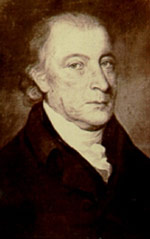
Dr. Samuel Stringer by Ezra Ames
On July 2nd, 1775, Dr. Samuel Stringer wrote to Philip Schuyler from Albany to congratulate him on his recent appointment to the rank of Major General and commander of the Northern Department. As a physician, he also made reference to Philip’s chronically poor health:
…permit me to offer you, among your Welwishers[sic], my most hearty Congratulations on your Appointment, and to assure I am… rejoiced to find you called ypon[sic] by your Congress to fill the important Post of a General in the American Army, in whose abilities, your Country will undoubtably[sic] place the greatest Confidence. I wish I could say so much for your Constitution, and that it may equal to the arduorus[sic] Task you have to engage, is my sincere prayer.
Shortly after this letter was sent, Schuyler approached Stringer about applying his medical services to the support of the Northern Department, a position confirmed by the Continental Congress on September 14th of that year:
  • Resolved, That Samuel Stringer, esq; be appointed director of the hospital and chief physician and surgeon for the army in the Northern Department.
  • That the pay of the said Samuel Stringer, as director, physician and surgeon, be four dollars per day.
  • That he be authorized and have power to appoint a number of surgeons mates under him not exceeding four.
  • That the pay of said mates be two thirds of a dollar per day.
  • That the number be not kept in constant pay, unless the sick and wounded be so numerous as to require the constant attendance of four, and to be diminished as circumstances will admit, for which reason the pay is fixed by the day, that they may only receive pay for actual service.
  • That the deputy commissary general be directed to pay Dr. Stringer for the medicines he has purchased for the use of the army, and that he purchase and forward such other medicines as General Schuyler shall, by his warrant, direct, for the use of the said army.

Stringer was a Marylander by birth, but had received his medical education in Philadelphia. Like Philip, Stringer had been involved in the French and Indian war - in Stringer’s case as a surgeon – and in the years leading up to the Revolutionary War, became a member of the Albany Committee of Correspondence. His connection to the Schuylers was also professional, tending to the medical needs of the family as one of the most prominent physicians in Albany. His appointment to the position of chief medical officer for the Northern Department was official recognition of a role he had already been performing since August. Problematically however, the wording of the resolution failed to explicitly denote his place in the chain of command relative to Dr. John Morgan, who already held the title of chief physician and head of the General Hospital of the Continental Army. This led to repeated clashes between the two men and their associates.

One of Stringer’s first and most pressing concerns was acquiring the actual medicine needed to care for the sick and wounded soldiers of the army. In the Summer of 1775, the future availability of medicine was uncertain. Stocks were high in cities like Philadelphia, New York, and Boston, but the specter of shortages loomed ever larger as the war progressed and regular shipments from England slowed to a trickle. Even before his official appointment, Stringer had been purchasing drugs for the army; purchases for which he was to be compensated by order of the Congress. Once acquired, Stringer also saw to the dispersal of the department’s medicinal supply to the various units of the army. On November 16th of 1775, he wrote to Schuyler to inform him that medicine was being sent to supply Revolutionary troops participating in the invasion of Canada:
Mr. Wimple & Mr. Williams are now packing up Medicines viz: will go off according to your Order, as soon as possible, with whom I shall send two thirds of all our Stock.
While medicine is an obvious concern to a medical officer, Stringer was also tasked with establishing the infrastructure and bureaucratic systems needed to keep the Northern Department Hospital corps effective. This included sourcing and acquiring the supplies needed to feed, clothe, and house the sick and injured. Many of his letters to Schuyler immediately after Stringer’s appointment deal with the minutia of constructing adequate shelter to provide for those in the care of the hospital. On October 6th, Stringer wrote from Fort George to report that:
…the want of Carpenters, Boards, Masons and Carpenters tools, will occasion such a delay, that I fear I shall be overpowered with Numbers before I can be in a situation to dispose of them—I shall have two Waggons[sic] Loads of Boards over to day, when I hope to have the last side of the wooden Barrick[sic] closed, which was entirely open—Mr. Yates tells me he has Tools for no more than four Carpenters… He is chiefly in want of Handsaws, and hammers…
With the impending winter, Stringer was also concerned with the abysmal state of the fireplaces at the fort.
The Iron which supported the Arches of the Chimneys having been all taken away, the Arches have fallen, & the Chimnies[sic] open to near the upper floor; the Backs are also burnt thro’, of each, & no bricks to repair either defect, nor Iron to replace what has been robed[sic] from the Arches, or to make a Grate under the large kettle.
Four days later he reiterated the request for masons and tools, as well as ever-in-demand medical supplies:
If there is such a thing as a mason to be spared from your Garrison, and Tools for him, beg you would order him (or more than one) over; otherwise the Sick will enevitably [sic] suffer much from the Cold… also a [book] or two of White Cartridge Paper for wraping[sic] medicines—I sent for Wraping[sic] Paper,  they have sent me the blue kind, that will not bare[sic] ink; & it will be necessary that every Mans Medicines are distinguished as they are made up, by his names on each, & directions.
Equally pressing, to Stringer’s mind, was the lack of support staff that he had to work with. The assistance of only four “as needed” mates in addition to himself left the hospital corps woefully understaffed, as Stringer well knew from his military experience in the French and Indian war. Moreover, recruiting capable medical officers at the poor rate of two thirds of a dollar for every day of service was proving nigh on impossible. Stringer wrote to Schuyler on this topic in several letters, laying out his recommendations at length on the 25th of October:
Sir…in my last [letter]…I took the liberty to point out a material deficiency of officers who are indispensably necessary in that Department, Viz: Senior Surgeons & Apothecaries; a Clerk & Steward… Two Seniors & Four mates (exclusive of myself) are as small a Hospital as the Army under your Command should take the Field with; & should there be an engagement, it would scarcely be sufficient---In the Resolution of Congress, I am limited to four mates only; I suppose the necessity for more ever so great, I cannot employ them; & even those four are to be dissatisfied [ie: discharged], and the numbers of Sick & Wounded decrease so as not to require the attendance of the whole; founded probably on the supposition that the Hospital was to be confined to Albany, where mates of an inferior class might be more readily procured in an emergency; for no Gentleman of Merit would on such Conditions enter into the Service--- We had Supernumerary Mates in the Kings Hospital during the late[sic?] War, but they were for the most part continued… because they were capable Mates, and already acquainted with the Hospital Service… I must further add, that the Pay being so small, will not be an encouragement for Gentlemen qualified to go out in the Service, & unless they can support themselves as such, they certainly will not enter into it.
In addition to these difficulties, Stringer repeatedly clashed with officers of the Northern Department and other branches. The Northern Department was frequently the cockpit for bitter disputes over the chain of command. Philip Schuyler and Horatio Gates battled for command with each other as Continental and Militia forces squabbled over levels of authority, civilian and military bodies parsed out their spheres of responsibility, and officers wrangled at length over seniority of commissions. On the 7th of November, Stringer wrote to Schuyler to air his complaints about the officers at Fort George.
Dear General!However loth[sic] I am to trouble you with Complaints (ever disagreeable) yet my Duty compels me to it, or the Hospital must great suffer, & myself be treated with Insults that I cannot possibly bear—I cannot say the Sick have been sufficiently supplied with Fuel since I returned from the other side of the Lake… [owing to the] Wood not being cut, and at other times, a neglect in detaining the Waggons[sic]… which I informed the Col: of…  His answer was, that I should give my Orders to the Officer of the Day… & HE would see they were executed. [I] wrote & sent [the Officer of the Day] as follows, “The Officer of the Day will be pleased to furnish a Party to cut Wood for use of the Hosp. and that he will please to see that the Hospital Guard remain at the Guard-Room”…The next morning I understood that the Col:, in presence of Lieut. Brazier… had expressed great displeasure at my presuming to give Orders, saying that my Orders were not to be obeyed—[I] let him know (very civily) what I had heard; upon which he showed great warmth, & repeated that I had no right to give Orders. I told him that it was what he himself had desired of me the evening before… He (with heat) denied it… I had the impudence enough to affront that what I said was true, & confirmed it with an Oath—He immediately desired me (with an air of importance) not to swear there… I replied that I thought myself at Liberty to swear there, & should do it—
Dr. John Morgan by Angelica Kauffman
The bigger dispute came, however, in Stringer’s clash with the Director of the General Hospital, James Morgan. Morgan was another prominent, Philadelphia-trained physician serving with the Revolutionary forces. His position was intended by Congress to supervise the General Hospital and other departmental hospitals. This meant that he understood that Stringer, as head of the Northern Department Hospital, would report to him and pass requests for supplies through the General Hospital. Stringer disagreed, citing that his position had been created a month before Morgan’s, and that nothing in the resolution appointing him to his position indicated that he was answerable to Morgan. Morgan himself seems to have been uncertain of how to address the situation, telling Stringer, “It has never been announced to me in what light I am to consider you.”

Stringer’s frustration grew when Congress confirmed the superior status of Morgan’s authority on July 17th, 1776, delineating Stringer’s authority “in the Northern Department only”. When their conflict continued, with Stringer asserting that Morgan was withholding key medicinal supplies, Congress finally resolved to divest themselves of both parties, dismissing both Stringer and Morgan without warning on January 9th, 1777. Philip Schuyler, frustrated and surprised by the dismissal of someone whom he considered a trusted officer and ally, and feeling the breath of a New England faction desirous of seeing Horatio Gates in command of the Northern Department on his neck, wrote a passionate letter to Congress. All he received in reply was a sternly worded censure.


Stringer’s dismissal was not the end of his and Schuyler’s association. He continued to provide expert medical care to the family, as he had even during his time with the Northern Department. In the 1790’s he would develop an early form of oxygen machine (based on English patterns developed by Joseph Priestley) for Philip’s use. A year younger than Philip, he outlived his general by thirteen years, dying at the age of 83 on July 11th, 1817.

Saturday, April 22, 2017

Calculating the Cost of Carpet

 by Ian Mumpton

Brussels carpet in the restored Green Chamber
at Schuyler Mansion State Historic Site.
 A while back on the blog we posted a short article on the  reproduced Brussels carpeting in the Yellow Parlor of  Schuyler Mansion (you can read it by clicking here if you  missed it). Carpeting of this sort was not only stylish and  colorful, but provided a luxurious and warm environment for  socializing in refined company. Its message lay not in its  mere cost, but in the genteel lifestyle that it communicated to  guests of the family.

 But still, it cost a lot.

Just how much is “a lot”? Well, in 1800, Philip Schuyler paid £68, 8 shillings for enough carpeting for five rooms of the house. In 1800, £68 8s was roughly equivalent to $275, or $5,136 in 2017 money. This basic calculation for inflation doesn’t truly convey the prices we’re talking about here. To get a more accurate idea of what $275 meant in 1800 in Albany, we need to look at wages and buying power.
"Threshing Grain" from
Diderot's Encyclopedia, 1762

According to figures provided by the US Bureau of Labor Statistics, in New York State in 1800, an agricultural wage laborer would have to work for just over a year and seven months to make $275. Again, that’s direct wages, not savings after housing and living expenses, making carpeting of this sort a luxury that very few people could ever even dream of.
What else could the Schuylers have purchased for £68 8s in 1800? According to a New York Senate report, you could buy a bushel of wheat in Albany for 12 shilling and 6 pence at that time, so £68 8s would give you just a hair under 66.75 bushels of wheat, or enough to make over 6,000 one-pound loaves of bread. This would keep a family of eight in bread for a year. If you weren’t looking for bread, you could always buy 820 fowl for the same price.

For the Schuylers, this luxury carpeting was more than simply another part of the trappings of their high-society lifestyle, but something which enabled it. The incredible expense of furnishings like Brussels carpet not only served to create a genteel environment for the Schuyler family, but was part of a fantastically exclusive lifestyle utterly unattainable for the vast majority of the population, including those whose labor generated that income. To their peers, such materials indicated wealth, refinement, and prestige, all of which culminated in the social power and authority which Philip sought for himself and his family.

Friday, March 31, 2017

Elbows, Ankles and Décolletage: Myths of 18th Century Women’s Fashion Part 1

by Danielle Funiciello

DISCLAIMER: This article features discussion about nudity and exposure in drawings and paintings. No nudity is shown within the article (except through a link which is marked), but language regarding the female form is used, and may not be comfortable for young or sensitive readers.

Until the social movements of the 1960s hit the museum world in the 1970s, there were a lot of problems with interpretation of female historical figures. One might argue that there are still a lot of problems with interpretation of female historic figures, though things are generally moving in the right direction. The age old excuse has been that there are not enough sources about women, and that this problem is upon us since women were not considered historically relevant in their own time, and so sources were not saved. Documentation about women is sometimes hard to come by, especially when it comes to ladies of lower classes, and the enslaved. There are two things, however, in women’s history of which there is no shortage:  images and myths. There are so many myths about women in the 18th Century, that today we will only be focusing on a few that relate to misconceptions about historical modesty, but we will be using lots of images to address these myths!

The Myth: 18th Century people were more sexually repressed and modestly dressed that modern people. It was scandalous for women to show their ankles or elbows in public because those were sexualized body parts – that is why women wore long skirts and ¾ or full sleeve gowns. Low-cut dresses were also risqué.


Given our modern concept of body and sexuality, we have very set notions about what is and is not appropriate and, because most of us are taught that our history begins with religious settlers like the Pilgrims, we tend to imagine that all Colonists were more prudish than we are. In actuality, outside of actual Puritans (and other conservative religious groups), the Colonial era was not very puritanical. As an example, up to one third of Colonial women went to the alter pregnant, depending on the colony.

Furthermore, sexualization of individual body parts is as different from century to century as it is from culture to culture. Much of what we now think of as the strict repression of “the past” (the first sign that a historical myth is misplaced is when the time period in question is vague) became set during the Victorian era (1837-1901).

The ankles myth, for instance, is one that comes out of 19th-Century lore and was applied back to the 18th-Century. Whether the ankles myth is true within the Victorian period is outside of the scope of this article, but it was not true of women in the 18th-Century. It would have been inappropriate for anyone of the genteel class, man or woman, to show any part of their leg without a stocking. However, lifting one’s skirts to expose the stocking-footed ankle was quite common. After all, it would have been dangerous to ascend stairs or enter a carriage without arranging one’s skirts to do so. Many women’s fashions of the late 18th-Century incorporated slightly shorter skirts in a style that was meant to imitate the pastoral, working-class shepherdess - and which allowed the ankle to be seen.
Two 18th-Century French fashion plates and a dress from the Kyoto Costume Institute (center) showing the popular shepherdess style gown which was meant to mimic (albeit unrealistically) working-class women's styles through shorter hemlines and bustled up skirts. Fashion plates were published and widely distributed to show popular styles to people living outside of high-fashion cities. Far from being a pornographic display of the leg, the image on the left was meant to show the styles of shoe, stocking, and garter appropriate to wear with such a dress.

A "Robe a la Turque" on a self-portrait of
Rose-Adelaide Ducreux, which clearly
shows her elbow exposed as she bends to
play the harp.
Similarly, the myth that women’s elbows had to be covered to avoid offending delicate sensibilities stems from observation of fashion tastes rather than any 18th-Century letters, drawings, or documents that discuss the attractiveness of the elbow or the scandal of the elbow being exposed. Three quarter sleeve dresses were quite popular in the mid to late 18th-Century, and while many such sleeves would have covered the elbow, many did so just barely, such that any bending of the arm would have exposed the elbow. It is true that there were not many short sleeved styles and that even if one wore a short sleeved dress, it was typically worn over a shift with full or ¾ sleeves.

Another "Robe a la Turque". This style, while
not defined by its' short sleeves, allowed the
wearer to layer fabrics in a way that displayed
wealth, especially when rich fabrics like silk
and lace were used.
There are two likely explanations for these styles. The first is that the linen shift undergarment was worn as an absorbent layer to remove oils and dirt from skin and protect the expensive outer garments from damage inflicted by the human body. It would not have been functional in this job if the shift sleeve was shorter than the gown sleeve allowing the skin to touch the outer garment. The second explanation for the style is that longer sleeves meant more fabric and more fabric meant more money. Short sleeves could be seen as skimping on fabric costs, but longer sleeves showed off one’s wealth. Layering sleeve lengths so that one could see the edge of the shift showed off even more fabric and thereby more wealth. Full length sleeves made of fine materials showed off one’s wealth even more, but restricted arm movement making it difficult to do any labor or, for that matter, leisure activities. The style became popular because many women chose the comfort of arm mobility but, among the wealthy, could use lace cuffs, ruffles, ribbons, and other costly adornments to suggest that the shortened sleeve was not an issue of money.


Catharine Van Rensselaer Schuyler
by Thomas McIllworth
Today’s article was prompted by a very frequent visitor reaction to portraits of Catharine Van Rensselaer Schuyler and her daughter Cornelia Schuyler Malcolm. It usually sounds something like this: “I can’t believe she’s wearing such a low cut dress! In that time period?!”

This is where our perceptions of what is, and what is not a sexualized body part come into play. More importantly, how body parts were considered sexual or vulgar has changed significantly. The upper chest, neck, and shoulders - the area referred to as décolletage, was considered a beautiful, but not overtly sexual area of the female body. Where we now consider too much exposed cleavage to be inappropriate, men and women of the 18th-Century did not seem to think much of the swell of the chest. France in the 1790s took this to the extreme with fashions that allowed the breast to swell over the top of the gown. These gowns were shown in numerous fashion plates which were not intended as parody or pornography. [DISCLAIMER: Some of these fashions plates, which do contain illustrations of nudity, can be seen on this blog. The link is provided only as a location to see these images in a centralized place. Schuyler Mansion is not affiliated with this blog and the interpretations made by EKDuncan’s blog are not representative of the arguments made in this article.]
Cornelia Schuyler Morton
by Thomas Sully - on display
at Schuyler Mansion.

The French captions under each drawing describe only the style and features of the dresses. They make no mention of the exposure caused by these gowns, implying that the low-cut nature was not necessarily expected to shock or offend the viewer. This was another way of displaying one’s wealth. After all, a dress which can so easily slip off the wearer is not designed for rigorous activity. It could only be worn by someone who had no need to perform labor. This would also explain why this extreme fashion never takes foot in the Americas – even wealthy women like Catharine Schuyler, who owned slaves to do the bulk of the labor, still had more hands-on responsibilities than women in the high-courts of France.

"The Inconvenience of Dress", published by
S.W. Fores, which mocks the preferred female
shape created by fashion trends.
Strangely, more lewdness was implied in parody images of women wearing too much clothing than none at all. Things like paniers, bum rolls, and layered petticoats which, to the modern eye, cover and obscure the human figure, were considered suggestive to the point of vulgarity by some in the 18th-Century. Back in the arena of décolletage; fichu - square or triangular scarves which were tucked around the neck and into the front of the gown) - are often considered modesty pieces by modern people. However, if worn in excessive layers – as became popular in the 1780s and 90s - they too were seen as being suggestive and showy; the 18th-Century equivalent of bra-stuffing, perhaps? The fichu was more about comfort of movement and display of fabric as, you guessed it, a symbol of one’s wealth.

Catharine Van Cortlandt Van
Rensselaer. Compare to Catharine
Schuyler's portrait, above.
An additional point of interest regarding Catharine’s portrait, is that it is very likely that the body shown is not Catharine’s Schuyler’s at all. The dress was certainly not hers, as it appears on a number of other women at the time, painted by a number of different artists. This includes Catharine’s younger cousin, Catharine Van Cortlandt Van Rensselaer who is shown so identically to Catharine Schuyler, that the artist, did not even change the folds in her sleeve. In all likelihood, sketches for the body of the portrait were made from a model wearing a false gown which the artist kept in his studio – this would allow him to paint accurately draped fabric from life. The features of the dress were then painted in in mimic of another portrait, probably one of someone that Catharine wanted to emulate. This process meant that Catharine only had to pose briefly, so that the artist could make a sketch of her face from life, but the rest of the painting could be done from the
artist’s studio, saving time and money.

The fact that the body shown was not Catharine’s was not a secret. People looking at the portrait within the time period would have understood the painting process. Thereby, even if Catharine would not have been comfortable showing this much skin during her daily life, she hardly had reason to be embarrassed by someone else’s body with her head slapped on top.


We have a lot more images and myths regarding women in the 18th-Century, so check back to the blog often if you liked this article. Additionally, since 2017 is not only the 100th Anniversary of Schuyler Mansion’s opening, but also of women’s suffrage, we are pleased to announce that a program on the “Women of Schuyler Mansion” will be available both as an outreach program, and as a focus tour of the museum during the 2017 season. Further details will be available on Facebook by May 17th, the first day of our open season.

Thursday, March 16, 2017

Moses Hazen; A Profile of One of Schuyler’s Military Contacts

by Danielle Funiciello

"Defending Quebec from an American Attack, December 1775"
The Quebec Campaign was one of Schuyler's first commands after receiving his commission.
On September 6th, 1775, Philip Schuyler arrived outside of “St Johns” (Sainte-Jean-sur-Richelieu – henceforth St. Jean, except in quotes), outside of Montreal. There he encamped and prepared his troops for a thrust into St. Jean that was part of the two pronged attack now known as the Invasion of Quebec. With Schuyler’s predilection for espionage, he was not going to go in blind, and sought information; he wished, of course, to know the size and condition of the British military at St. Jean, but also hoped to find Canadians sympathetic to the American cause. Within the day, Philip Schuyler received that information without even seeking it out. As he wrote to George Washington:

“In the Evening a Gentleman Mr [word  mutilated by Washingtonwhose Name I can only mention to Your Excellency, not having even ventured it to the Congress & therefore beg You to eraze the Scored Part of the Letter after Perusal came to me & gave me the following account,” September 20th 1775  (the scored part refers to the words in italics - Washington only crossed out Hazen's name, rather than the scored instructions) 

Who was this mysterious gentleman? Why might not Schuyler have been keen to share his source with Congress? And what was the source’s motivation for bringing Schuyler information? The answers tell the story of a sometimes dark, opportunistic and intriguing character in the American Revolution.

Through later records, the name scratched out by Washington per Schuyler's instruction in this letter is identified as Moses Hazen, a former British soldier who had fought in the French and Indian War and purchased property and retired in St. Jean just before the outbreak of the Revolution. He was only a few month older than Schuyler and joined the military within a year of Schuyler’s commission. The two men’s French and Indian War career paths began similarly and gave them a number of opportunities to have met prior to this night in 1775. Schuyler had a handful of operatives available in the Montreal area, so the fact that he trusted Hazen’s intel rather than, or in addition to, seeking out other sources may have been indicative of a previous connection that led Schuyler to trust him. 

It is likely that Hazen was the same “Canadian,who twelve days ago left St Johns” who Schuyler collected information from earlier that year, just after his arrival at Fort Ticonderoga. That letter of July 18th echoes that of September 20th in another way – Schuyler warns Washington  “this, my dear General, as well as what follows in this paragraph I pray may be entre nous [between us] for reasons I need not suggest”.

The fact that Schuyler was hesitant to bandy the name Hazen about Congress may be further evidence that Schuyler was at least familiar with Hazen’s reputation – Hazen’s military past was, at best, morally ambiguous.

An 1812 political cartoon showing British officers paying for
American scalps. Though the cartoon implies otherwise, this
was practiced by Americans as well. During the French and Indian
War(1754-63) both sides used scalp taking as a demoralizing fear tactic.
General Jeffery Amherst, 1st Baronet; disproved
of Hazen's attack on Acadian women and children
during the French and Indian War. He also authorized
the use of smallpox blankets as biological warfare
against entire tribes of Native Americans.
During the French and Indian War, Hazen had served under Captain John McCurdy, in a company under Roger’s Rangers. When McCurdy was killed in 1759, Hazen was promoted to command the unit. Under Hazen, the unit was known for their participation in raids - burning hundreds of Acadian (French) homes - and engaging in other scare tactics like scalping, a brutal practice adopted by Europeans and Native Americans alike on both sides of the conflict. A raid of Sainte Anne during the St. Jean River Campaign sticks out as a particular mark on Hazen’s defendable reputation, during which Hazen’s men captured Josef Godin-Beaufontaine and his Acadian militia. Hazen took 6 scalps, 23 prisoners and, in trying to goad Godin-Beaufontaine into signing an oath of allegiance, the lives of Godin-Beaufontaine’s daughter and three of his grandchildren. Some versions of the story have Hazen burning the women and children in their home, along with four members of the militia. Hearing news of the new Captain’s actions during the raid on Sainte Anne, General Jeffery Amherst condemned Hazen saying “that affair has sullied his merit with me” – this is the same General Amherst who ordered blankets from smallpox wards to be sent among the Native tribes. Before settling down in St. Jean, Hazen was also accused of involvement in the scalping of a priest and thirty parishioners, and of having an affair with the wife of one Joseph Kelly. Kelly further claimed that Hazen had him imprisoned with a false charge to avoid the issue of the affair. To top off his apparent untrustworthiness, Hazen had also reported on the first skirmishes of the Revolution to British General Carleton during the early months of 1775 and had been authorized to form a British unit, though he declined to do so.

We do not know if Schuyler was aware of these actions, but either based on a previous association with Hazen, or some other instinct, Schuyler chose to trust Hazen’s military intelligence and passed the following information to Washington:

That there were then at St Johns about 100 Indians & that there was a considerable Body with Colo: Johnson; That the Fortifications were compleat [sic] & strong & plentifully furnished with Cannon; […] That he does not believe that our Army will be joined by one Canadian; […] That in the Situation we were in he judged it would be imprudent to attack St Johns and advised Us to send some Parties amongst the Inhabitants & the Remainder of the Army to retire to the Isle-au-Noix, from whence we might have an Intercourse with La Praire”

The original plan of attack of Montreal through
St. Jean, shown in blue. This plan allowed Schuyler
to use bateaux he had built at Ticonderoga to move
troops and supplies up the Richelieu River. The
alternate approach, suggested by unaligned Hazen
is shown in green. After taking Montreal, Schuyler
was to join in an attack from the south on Quebec.
 Benedict Arnold led troops through Maine to
attack Quebec from the North.
This bleak report was a blow to Schuyler, who had been hopeful that his surge into Canada would be met with enthusiasm from Canadians. He had believed that militias from St. Jean, sympathetic to the Revolutionary cause, would join him for the push into Montreal and through to Quebec and that the Natives would remain neutral. This information may have been particularly disheartening in contrast to the letter of July 18th. If “A Canadian, who twelve days ago left St Johns” was in fact Hazen, he had ensured Philip “that there are many Indians in Canada, but believes neither they or the Canadians will join [the British forces]”.

Schuyler’s hope was further dampened by illness sweeping the army. He reports that the troops “returned on Monday the Eleventh, on Tuesday the twelfth I found I had upwards of 600 sick, Waterbery’s Regiment being reduced to less than 500” and that he had fallen ill as well.

All of this in concert led Schuyler to fall back to Ile-aux-Noix, just as Hazen had suggested, to reconsider the attack on St. Jean.

But reports from James Livingston said that he was successful in raising troops near Chambly (eventually the 1st Canadian Regiment under Livingston's command) and in transporting cannons within range of St. Jean where he reported much more favorable odds for the Continental Army - making it sound like Hazen’s intel was either incorrect or exaggerated. The attack would go forward on September 17th, by which point Schuyler had turned over command to General Montgomery in order to deal with an attack of gout.

In the meantime, Moses Hazen had returned to his home in St. Jean. The series of events that followed lead us to question what his true motivation was for the news delivered to Philip Schuyler at the eve of the siege of St. Jean. Was Hazen presenting accurate information or slanting the facts in hopes that the battle would circumnavigate St. Jean? Was he hesitant to come out of retirement or undecided on what side to come out of retirement for? Was his primary concern just the preservation of his home and property value?

During the attack on the 17th, John Brown, a spy who had also been reporting back to Schuyler, came in contact with Hazen during a skirmish north of the Fort and arrested him. It is unclear if Hazen participated in the skirmish in any way or was just arrested because his loyalties were unknown. He was held only briefly by the Americans before Brown’s men were attacked and Hazen was abandon to the British, who arrested him in turn. In the meantime, General Mongomery informs Schuyler that “Mr Livingston some Days ago took Post at Hazen’s House with near 200 Canadians, they are erecting a Battery there, which seems to make the Garrison very uneasy”. Given the quick turnover, it is possible that Hazen did not even know that the Continental Army had set up their base of operations on his estate just across from the Fort in St. Jean.

Hazen would not return to his home for some time as he was instead sent to Montreal where he was imprisoned under General Carleton for nearly two months. As the Continental Army pushed through St. Jean into Montreal, Hazen was once again abandoned in transfer. According to the Dictionary of Canadian Biography, Hazen claimed that Carleton had again offered him a command under the British, but he once again refused on his loyalties to the American cause. He claimed that the unpleasant conditions of his imprisonment further solidified his loyalty and he officially joined the American army during their attack on Quebec.

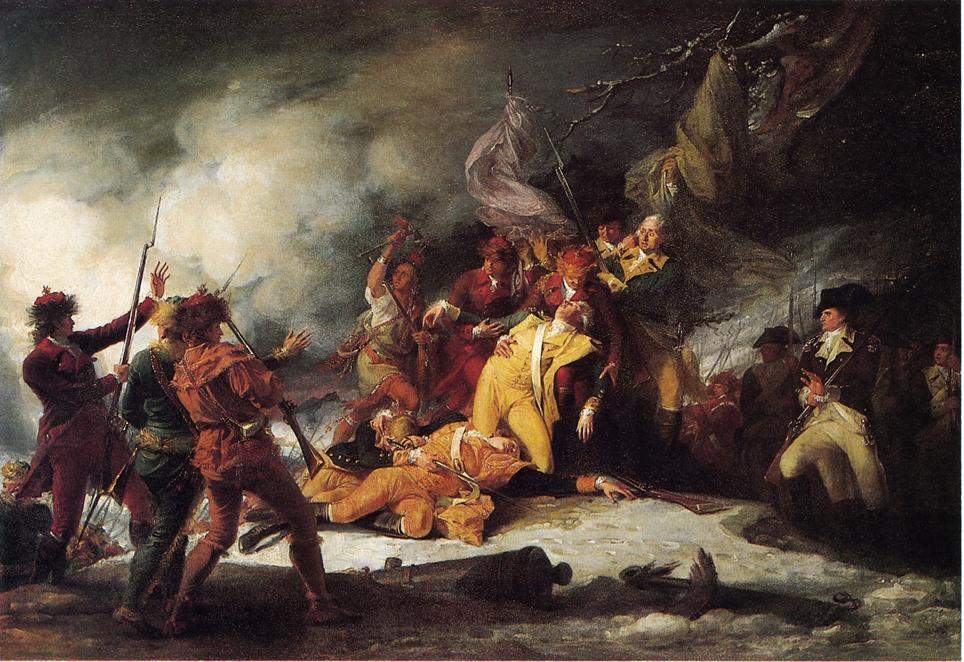
Image result for death of general montgomery
Hazen was present for the Death of General Montgomery during
the siege of Quebec in 1775 and was sent to Congress to report
on the battle.
Somewhat strangely, less than two months after joining the American cause, Hazen was sent as an envoy, alongside the decade younger Edward Antill to report to Congress on the death of General Montgomery and the course of the Quebec campaign. In asking Congress to send reinforcements, Hazen negotiated that one of the two Canadian units formed, would be under his own command. The 1st Canadian Regiment was promised to James Livingston by General Montgomery, while the 2nd Canadian Regiment was intended (by Benedict Arnold, who led the second arm of attack during the Quebec campaign) to be given to John Duggan. In addition to usurping Duggan’s commission, Hazen negotiated monies owed to him for the use and damaging of his property and an agreement regarding the future treatment of his property in St. Jean for the remainder of the war. He, rather ridiculously, valued the property damages upwards of $11,000, though Congress was only willing to pay him about 20% of that.

Benedict Arnold had multiple spats with
Moses Hazen. The feuding perhaps
began when Hazen usurped a position
Arnold promised to another officer.
Hazen’s 2nd Canadian Regiment was unique because he negotiated it to be commissioned directly through Congress, gaining it the nickname “Congress’ Own”. This also led to some questions surrounding to what degree he had to follow the typical chains of command. Obviously, he had to obey other direct commissions issued by Congress, like Generals Washington and Schuyler, but if a command contrary to his orders from Congress came from a brigadier general of another unit, would Hazen, as a lower-ranking colonel still have to obey? Hazen did not seem to think so and faced multiple courts martial for an insubordination charge by Benedict Arnold who was at that time a brigadier general. Hazen was repeatedly cleared through three years of on-and-off litigation throughout the war.

Hazen’s propensity for legal action did not start or end with Arnold. Before and after the war, he was persistently embroiled in lawsuits, including several with Congress and the government. Right up to his death, he was suing for further wartime property damage and use and remuneration for wages lost. He argued that since he had been retired on British half pay before the war, he should be recompensed by Congress that half pay which he had forfeited by joining the Continental Army. Though the case was still open at his death, his family did eventually win over $6,000 in that suit.

We tend to think of American Revolutionaries as a set type, but in reality, there were numerous personalities and numerous reasons why individuals did, or did not join in the Revolution. For Revolutionaries and Loyalists alike, the decision to join the war on either side was not always a clear one. Moses Hazen, though he may have initially intended to stay retired, weighed his options based at least partially on which side he felt would ultimately benefit himself and his property. Not joining the war in favor of continuing one’s daily life was not an option for most. Refusing to choose a side, as we see Hazen attempt at first, was considered tantamount to treason by both sides, which is very likely why Hazen was bounced back and forth, captured by both armies before his loyalty was made clear. Perhaps Philip Schuyler, who took Hazen’s intel but made no attempt to capture him nor gain an oath of allegiance from him, understood the hesitance to declare oneself. Philip’s military mentor, John Bradstreet - who had immense influence over Philip and lived with the family at Schuyler Mansion - would have almost certainly remained loyal to the British crown had he not died in 1774. Philip joined the Continental Congress soon after, but one can presume that had Bradstreet survived into the war, that decision would have been much more difficult.


If you liked this profile and would be interested in learning more about the military contacts in Schuyler’s career, please let us know in the comments. Schuyler Mansion will reopen for our full season starting May 17th, 2017. Follow our Facebook page for more articles and updates on the exciting events of our 2017 centennial season.