Friday, March 10, 2017

Searching for the Enslaved Women of Schuyler Mansion

by Ian Mumpton

One of our ongoing projects at Schuyler Mansion is to attempting to uncover the identities, relationships, and, where possible, the daily lives of more than thirty people of African descent enslaved by the Schuyler family. Two of our recent articles have focused on specific individuals or groups of individuals mentioned in the surviving documentary evidence (to read them, click here or here). Both of these articles have been about men, however the Schuylers lived off of the labor of both men and women. It can be difficult to determine exact figures, however later records suggest a near equal divide between male and female in the enslaved population of the household. For example, in 1798, Philip Schuyler was listed as owning eleven slaves, including three men and one boy, and three women and two girls. Similarly, the manumission record filed after Philip’s death in 1804 established the free-status of two men, two women, and three children (two boys and one girl).

A modern recreation of a light laundry day. The enslaved
women of Schuyler mansion would have dealt with much more
clothing than this for a household as large as the Schuylers.
Clearly, the labor performed by enslaved women was considered valuable enough for women to make up roughly 50% of the enslaved workforce of the family. Despite this, women are mentioned far less frequently in the surviving documentation than men. For example, a receipt from 1771 for shoe purchases and repairs mentions twenty enslaved people by name. Fifteen of those listed (75%) are men, while only five (25%) are women. This doesn’t necessarily indicate a larger male population than female; simply that in the Fall and Winter of 1771 more men needed new or repaired shoes than did women. This can give us an indication of the differences between the work performed by enslaved women and enslaved men. As mentioned in previous articles, many of the men were tasked with transporting goods and people between Schuyler’s properties in Albany and Saratoga. Others appear to have assisted with mill work and were put to work cutting timber. This sort of labor would have worn out shoes more quickly than the primarily indoor, domestic work performed by women. That is not to say that this work was necessarily more arduous than the hours of hauling water (at least 260 lbs. of water were needed for a laundry day), scrubbing clothing and dishes, and other chores tended to by enslaved women; the nature of the work simply required more travel time, thereby causing men to appear more frequently in the receipt.


One of the difficulties in reconstructing specific details about the lives of enslaved women in the Schuyler household arises from the fact that, unlike their male counterparts, women are very rarely referred to by name in the surviving documents. Of the thirty eight named individuals clearly identifiable in the documents as enslaved, twenty-nine (76%) of those identified by name are men or boys. Nine (fewer than 25%) are women or girls: Bet, Britt, Diana, Jane, Libey, Moll, Phoebe, Silvia, and Tallyho. Instead, Philip's letters and business papers refer to women in general terms, even in sources where men are referred to by name. For example, according to a medical receipt from 1755, Philip paid for medicine for two enslaved people. The man is identified as Mink, while the woman is only identified as “your Negro woman”. In 1762, the Schuyler family paid for the field labor of “a Negro man and Wench”, neither of whom are named in the source. In 1788 John Bradstreet Schuyler received a letter from his father, Philip, discussing his recent purchase of “a wench” from a man named Wendell for £60.
A Woman Doing Laundry, date unknown, by Henry Robert
Moreland. This highly idealized image of domestic work bears
little resemblance to the reality of women's labor in the Schuyler
household, performed by enslaved women and girls.

Explaining this disparity is difficult, but there are several possibilities. The documents which preserve this information were written by Philip Schuyler, his sons, and their male business counterparts. Most of them are letters describing travel or transportation of goods between Albany and Saratoga. They are almost entirely devoid of discussion of domestic tasks and daily life in the home, which would have been largely administrated by Catharine herself. Unfortunately, only one of Catharine Schuyler’s letters has survived, and it makes no reference to the enslaved servants. This lack of documentation results in a historical silence regarding the labor of enslaved women - one which is very hard to break.

One example from family sources which indicates the differing spheres of male and female supervision of slaves comes from Johannes Van Rensselaer’s (the father of Catharine Van Rensselaer Schuyler) 1782 will which stipulated that his wife was to receive “one negro wench” and “a negro boy called Rob” upon his death. In this case the woman is unspecified because Mrs. Van Rensselaer was expected to choose who she wants to keep, however John specifies that she also keep Rob. Rob is described as a coachman, and his labor would have fallen under John’s supervision.
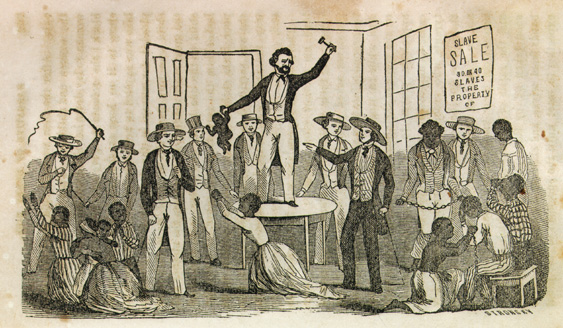
A 19th century Abolitionist print depicting the breaking of a family,
as an infant is sold away from their mother. While intended to arouse sympathy
for the enslaved, the raw emotion of the print captures the reality of too many
individuals who found themselves separated from their loved ones.
More often it is possible to perceive enslaved women in terms of their relationships with other people. For instance, Philip mentions to one of his children in a letter from 1782 that, “Your mama will strive with all in her power to procure you a good wench[.] They are rare to be met with, the two which I bought Last fall out of Charity, least [sic] their master… should dispose of them contrary to their inclinations, prove worthless in the extreams [sic].” While neither woman is mentioned by name, this tells us several things. First, that these two women had some sort of close relationship, be that mother and daughter, sisters, or simply close friends. Second, we know that this relationship was strong enough for them to indicate to Philip their desire not to be separated. Separation from loved ones was a common situation for enslaved New Yorkers, as the number of slaves owned by any one family was relatively small, “necessitating” the sale of family members away from each other.*


While the daily lives of the women enslaved by the Schuyler family may be hidden by scarce historical resources, even more so than for their male counterparts, by combining close readings of the existing sources with demographic records and a contextual understanding of the wider experiences of enslaved women, we hope to begin to uncover more information about their experiences in some of our upcoming articles. Stay tuned! In the meantime, make sure to check out other series on the restoration of the mansion, explore the fascinating face of the Revolutionary War in the Northern Department, explore our collections and documentary evidence, and challenge some longstanding myths with Mansion Mythbusters. What sorts of questions do you have about the lives of “the Servants”? Let us know in the comments!

For an examination of the amount of labor that went into tasks like laundry, click here to read an excellent interpretive piece from Woodville Plantation in Pennsylvania.


* To what degree Philip attempted to avoid this or not will be the topic of an upcoming article.

Wednesday, March 1, 2017

"In all Causes of Passion admit Reason to Govern": Questioning the Crafted Identity of our Founding Fathers

by Ian Mumpton

We were out of the office on Monday, so we missed a “This Day in History” Facebook post on the 27th. This gives us the perfect excuse to turn that Facebook post into a short blog article! On February 27th, 1769 Henry Van Schaak of Albany wrote his brother a letter revealing a side of Philip Schuyler that one does not often see in the history books:

The dispute between Col. Schuyler and the brewer Anthony… was briefly this: the latter had said, at the Coffee House, that the aim of the Colonel’s motions in the House was popularity, and added something which I forget. The colonel immediately armed himself with his sword, went to the Coffee House and other public places thus arrayed. I saw him come in this manner into the house of Assembly, ‘tis said in search of Anthony, not meeting with him, he called upon his at his own house where [Anthony] says he asked [Schuyler’s] pardon.

We mentioned this letter a few weeks ago in a blog article on 18th century Colonial Swordsmanship (you can read it here), however today we will be discussing it as it relates to concepts of public perception and the crafting of an appropriate and refined identity in the late 18th century.

At the time of his death in 1804 (just three days shy of his 71st birthday), Philip Schuyler was a well-respected and highly esteemed gentleman, praised for his public service, sharp intellect, and cool, elevated demeanor. The announcement of his death described him as follows:
A man eminent for his useful labors in the military and civil affairs of our country…Among all those grand actors in the heroic history of our country whose shadowy outlines are now but faintly visible through the smoke of revolution and the haze of an intervening century surely none should be more proudly recognized than General Philip Schuyler… He was a practical not a theoretical statesman, an active not a visionary patriot. He was wise in devising, enterprising and persevering in the execution of plans of great and public utility. The death of such a man is truly a subject of private and of public sorrow.
For a man of Schuyler’s position, this carefully cultivated air of gentility was as important to his public presentation as his expensive clothing and elegant house. He was not alone; a moderated outward expression was considered a praiseworthy ideal by many of the landed gentry, who saw their behavior as a badge of good breeding and civility. As a young man, George Washington recorded his advice on proper behavior and etiquette, which included such maxims as, “Use no Reproachful Language against any one neither Curse nor Revile” and “Let your Conversation be without Malice or Envy, for 'is a Sign of a Tractable and Commendable Nature: And in all Causes of Passion admit Reason to Govern”.

Horatio Greenough's 1832 idealized depiction of Washington
conveys the sense of reserved authority and cool
gentility which Washington himself actively cultivated
in his daily activities.
Often, the popular image of our founding fathers is as calm and collected gentlemen, stern yet moderated in their every action, handing down our fundamental American legislation with benevolent tranquility. This is a crafted image however, both in its own time and today, as the ideal which these men evinced to the world replaces the intricacies of their human passions and motivations. For example, while Horatio Greenough sculpted Washington in majestic serenity a la Zeus himself, Washington was known for powerful outbursts of temper, one instance of which Alexander Hamilton cited as his reason for leaving Washington’s staff in February, 1781, to resume his field commission.
Philip Schuyler is reported to have been subject to even more violent rages. During the retreat from Ticonderoga in 1777, Chaplain Hezekiah Smith reported in his journal:
...Lord's Day and very awful Day on the Account of Gen. Schuyler's conduct who acted more like a mad Man than the Commander in Chief. He beat some of the Soldiers who were performing their duty. He cursed, damned swore, profaned the Name of God in a most horrible manner, and Swore by his Maker that if he could light of the Major of our Brigade [Peter Harwood] that he would split his Head Open and scatter his Brains about the Ground. He attempted to thurst [sic] an Officer thro', and afterwards made his brags of it, that it was happy for the Officer and unlucky for the service that he had not killed him, many particulars of like conduct.

While Smith’s account is anecdotal, it does raise the issue of perception. Men like Philip Schuyler or George Washington’s characters and personalities were perceived by different people in very different ways within their lifespans, both positively and negatively, and yet today only that image which they desired be projected to the public has survived in our collective imagination. The past is often used as a resource by the present, whether to understand our own experiences as part of a larger narrative or to influence our actions and perceptions based on our relationship with the past. Every time we ask ourselves, “What would our Founders think of ______?” we participate in this process. That is not necessarily a bad thing, in fact it can be an important and enlightening activity, but we must always remember that things are not always what they seem to be, and we cannot always take the public perception of the time to be an accurate reflection of an individual’s life or actions. As we explore our shared past, especially when we find that past a little bit too comforting, it is important to remind ourselves and each other to actively question those things we would maybe rather not. The answers may not necessarily need to change the overall narrative, but they will almost always yield a richer, more complicated story.

Friday, February 24, 2017

Who Were "The Servants"? Tom and Lewis

By Ian Mumpton

The Schuyler family left a wealth of documentary evidence that can often let us piece together surprisingly intimate details of their lives, despite being separated in time by more than two centuries. This sort of work is much more difficult when it comes to the lives of the enslaved. Often we are left attempting to reconstruct identities, activities, and relationships from a few scattered references in letters and receipts. However this paucity of sources should not, and need not, obstruct us from attempting to glean key details about the lives of these men, women, and children. Even minor details, when looked at in the context of the period, can yield important results. In this edition of “Who Were the Servants”, we will focus on two men about whom very little is known, but whose recorded experiences can tell us a lot about the different types of labor performed by the enslaved for the Schuyler family.

Col. Richard Varick, to whom Schuyler wrote on
October 12th, 1777 painted by Ralph Earl, 1787
.
On October 12th, 1777, Philip Schuyler dispatched a man named Tom, along with another unnamed “servant”, to the remains of his country seat at Saratoga. The house that had previously been the heart of a sprawling farming estate lay in ashes, burned by British troops under General John Burgoyne following the battles of Saratoga, along with numerous other buildings and military stores. Tom had been enslaved by the Schuyler family for at least two years at this point. The earliest extant mention of his name is from 1775, when Philip paid 3 shillings 6 pence to a Jacob Hendrick for “1 pair of shoes mended for Negro Tom”. On this day, however, Tom and his unnamed companion had been tasked with beginning the process of resurrecting the family estate. As Schuyler wrote to his then-secretary/aide  Richard Varick:
Dear sir,
I send up Tom and another servant to pick up the Iron work of the Buildings which the Enemy have burnt. If you can possibly procure some hands to assist I wish you to do it as Iron and nails are at present very scarce, and I wish that what can be saved should be carried to the mill house at the upper mill… If I am not too much indisposed I propose riding up to morrow or next day. I wish you would direct Tom to see what Forage there is on Guiles farm either Cut or Standing.
Wether there are any turnips or potatoes remaining. –wether the wood work of the ploughs which was left near the turnip patch is still there. Wether there is any feed in the field upon the hill that was intended to be sowed with wheat this fall… I intend immediately to have my mills rebuilt and some house Erected.
     I am Dr Sir Affectionately
                 And Sincerely Your Obed.
                                             f.hl Servant
                                                         Ph Schuyler
A Black soldier of the 1st Rhode Island
Regiment.
 Despite incurring  Philip
Schuyler's disdain, African American
soldiers, both free and enslaved, served with
distinction on both sides of the Revolution.
 Brief as it is, this letter can tell us a good deal. For example, the letter is dated October 12th. While the most recent clash between the British and Separatist forces at Saratoga had taken place on the 7th, skirmishing continued until the 13th when Burgoyne’s British forces were finally surrounded. Philip Schuyler was so eager to rebuild that he sent his servants to begin the process before the final cessation of hostilities in the area. Given the stated scarcity of iron, this is understandable, but it also reinforces a crucial point: the Revolution was not a conflict reserved to the battlefield and soldiers. Civilians of all classes, Separatist or Loyalist, free or enslaved, continued to live their lives in the closest possible proximity to the bloodshed. For the enslaved, the confusion of the war offered little respite from day-to-day labor. It could offer other opportunities in the form of freedom through service, however, for those enslaved by the Schuylers, there was no hope of gaining freedom by assisting the Revolutionary cause; Philip considered the presence of Black troops, “mortifying barely to mention…” and only a few months before had referred to them as a “disgrace [to] our arms.” At the same time, fears that the enslaved population would provide assistance to the British had prompted a law to be passed in Albany in 1775 that any enslaved man found more than a mile from home without his master’s permission could be shot on sight*. For this reason, Tom may have carried a letter signed by Philip which he could present as evidence that he was not attempting to flee to the British.

The Saratoga estate was a long day’s travel from the Schuyler house in Albany. Philip’s letter to Varick reflects a large amount of responsibility and autonomy being put on Tom. Not only is he tasked with collecting the valuable iron remnants of the house, but with ascertaining the condition of various crops elsewhere on the estate. In contrast to the perception that all slave labor was unskilled, menial work (e.g. sifting through ashes) this provides further evidence that many of the enslaved were engaged in specialized and/or skilled services with a surprising amount of autonomy and limited supervision, yet still saw their labor exploited for profit and comfort.

Unfortunately, we know little else about Tom. Records indicate that he was still enslaved by the family in 1789 when he received medical treatment from Dr. Samuel Stringer for an unspecified illness. Assuming that he was at least eighteen years old in 1777 (a reasonable assumption given the amount of responsibility placed on him), that makes him least age thirty at the time of his last mention. It is possible that he recovered from his illness and either remained with the Schuylers or was sold. It is also possible that he died of his illness at that time. In either case, this letter provides a window into a day in his life, one which indicates the variety of work a man in his position could have been expected to perform.

The other subject of this article is even more of a ghost in the documentary record; Lewis is known to history only by a single letter written by Benjamin Franklin to Philip Schuyler in May of 1776:
Dear General:We arrived here [NYC] safe yesterday Evening, in your Post-Chaise driven by Lewis. I was unwilling to give so much trouble, and would have borrowed your sulkey and driven myself, but good Mrs. Schuyler insisted on a full Compliance with your Pleasure…and I was obliged to submit; which I was afterwards very glad of, part of the Road being very stoney and much gullied; where I should probably have overset and broke my own Bones; all the Skill and Dexterity of Lewis being no more than sufficient. Thro’ the Influence of your kind Recommendation to the Innkeepers on the Road, we found a great Readiness to supply us with Change of Horses…    
This letter mentions Lewis twice, both times in the context of his role as Franklin’s driver. The lack of other documentation means that we cannot determine Lewis’ age, health, relationships to others, appearance, or any of the other details we might desire to know about him, and yet this letter is not without its own insights.

Most obviously, this letter tells us that Lewis was a coachman. This is extremely specialized service requiring an ability to handle animals in often difficult conditions while properly reflecting the refinement of the family claiming ownership of your person and labor. Lewis not only knew how to drive a team of horses (which itself also assumes an ability to work with and care for the animals and their equipment), but, to be selected for this task, would also have been trained in the etiquette of refined servility, attending Franklin during the journey. The fact that Lewis would have been viewed as an “object” of display, reflecting on both the Schuylers and Franklin, means that he likely wore better clothing than a man like Tom would have, tending to the Saratoga estate. However Lewis did not have a “cushy” job by any means. Travel in the 18th century was arduous in the extreme; Franklin’s reference to risking broken bones was no hyperbole. Upsets, broken axles, rutted roads, and injuries to the horses themselves were a common feature of overland travel at this time (not to mention the fact that Lewis would have been in 24/7 attendance upon the notoriously irascible Franklin**).
A satirical image of the dangers of travelling by carriage. While the image lampoons the Scots, the roads in NY were often not much better.
The references to these two men that have survived, few as they are, paint a varied picture of the sorts of work performed by the enslaved. Both men are described working in different spheres of the Schuyler’s lives. Tom collected iron while Lewis drove a carriage, and yet interwoven between these apparently different worlds there are recurring themes of autonomy and skill juxtaposed with exploitation and a reminder than just because we may not know all the answers does not mean we should not ask the question, “Who were they?”


*See p. 301.
** For John Adams description of Franklin as a travelling companion, click here.

Wednesday, February 15, 2017

Update: The Ruins of Rome Wallpaper Install

by Danielle Funiciello

The downstairs (left) and upstairs(right) hallways of Schuyler Mansion as they appeared in previous seasons. Both spaces were meant to be overtly stylish spaces in Schuyler's day - the downstairs hall was the first impression visitors got of the home, while the upstairs "Salon" was the largest room in the house, which was used for dances, feasts, and other festivities.
Visitors to Schuyler Mansion during our “Salutations of the Season” event on January 7th got a sneak peek at a much talked-about project that has recently come to fruition; the reproduced “Ruins of Rome” wallpaper that once, and now again fills the hallways of Schuyler Mansion.

As previously discussed in our article about the start of this project (here), the “Ruins of Rome” was a paper produced in England during the mid-1700s. Philip Schuyler’s receipts from the initial construction of the home show purchase of enough “Ruins of Rome” paper to cover both the large downstairs entry hall and the even larger upstairs central hall or “salon”. The paper would have also been applied to the staircase connecting the two.

As one might imagine, a detailed, historic wallpaper like this creates a number of challenges in addition to the usual difficulty of modern wallpaper, both in production and installation.

High resolution prints of the "Ruins of Rome" wallpaper receive a UV coating
at Peebles Island Resource Center, September 2017.
Rich Claus and Erin Moroney of the Peebles Island Resource Center went above and beyond the call of duty in creating our high quality digital reproduction of the paper, which was spliced together from two different sources. It had to be perfectly modeled to fit the dimensions of Schuyler Mansion and account for the overlap that would result from the installation process. Once the paper was printed, Erin Moroney and paintings conservator Mary Betlejeski applied a UV coating to protect the color from fading over time. Not only did the Peebles Island team execute this project beautifully but, even after retiring this past year, Rich Claus continued to volunteer his time to make sure that the project was a success – we thank him greatly for this!

Charlie Gilley puts finishing touches on
wallpaper panels in the stairwell at
Schuyler Mansion, January 2017.
Members of Gilley Paint and
Restoration LLC prepare paper
panels for installation in the Salon
at Schuyler Mansion, January 2017.
Once the reproduction was finished, it was handed into the capable hands of Charlie Gilley and his team from Gilley Paint and Resoration LLC, for installation. Installation began late in November, but some visitors may have noticed; only the small back hall had paper by our January 7th event. This is because a key initial step was preserving and covering the existing wallpaper in the upstairs salon. Called “Eldorado”, this paper by the Parisian company Zuber has been produced since 1848. It was installed at Schuyler Mansion as part of the earliest museum interpretations around 1914. Being over 100 years old and in excellent condition from being in the controlled museum environment, it was important to preserve this beautiful artifact in state. Therefore, before "Ruins of Rome" could be installed, paneling had to be installed to create a faux-wall surface that the new paper could adhere to. “Eldorado” will remain protected beneath the “Ruins of Rome” for future generations.
Panels of Eldorado, a woodblock printed paper which has been in production by French company Zuber since 1848.
Eldorado was installed in the upper hall at Schuyler Mansion during the 1910s to give an approximation of the
type of paper Philip Schuyler purchased for his home. 

The final results are stunning. Rather than the sparse interior which has greeted visitors for 100 years, walking into the mansion is like now like stepping back in time. Philip Schuyler vision for his home was calculated. Each element was designed not only to impress guests once they arrived at the home, but to encourage wealthy and important guests to come in the first place; thereby creating networking opportunities for the Schuyler family. The size and grandeur of the home was successful – drawing visitors like the Washingtons, the Marquis de Lafayette, the Marquis de Chastellux, Benedict Arnold, and even Benjamin Franklin, who had a letter of introduction written so that he could stay at Schuyler’s when travelling through Albany. The “Ruins of Rome" helps historians and museum visitors alike understand the first impression that accomplished this.


The front hall at Schuyler Mansion looking towards the
front door. With the "Ruins of Rome" wallpaper in place,
the space is brighter, more impressive, and feels more open,
as it would have been with the Schuylers in residence.


Our public unveiling event for the “Ruins of Rome” wallpaper will correspond with our July 4th Independence Day celebration this year, though Friends of Schuyler Mansion Members, who matched the grant to pay for this project, will have an earlier unveiling, and visitors can see the completed installation on Hamilton Tours and during the regular season beginning mid-May.

Friday, February 3, 2017

Dressing the Part II- Johnny Schuyler, King of Swag

by Ian Mumpton

Last week we put up an article about receipts from Sothebys detailing high-end fashion purchases made by the Schuylers  in the 1760’s and early 1770’s. The types of finery referred to in these receipts would have been instrumental to the family’s identity. Textiles and personal adornment were a means for displaying not only their extravagant wealth, but an even more pervasive element of refinement, gentility, and power. The clothing described was not only expensive to buy, but followed the latest European trends, showcasing the Schuylers’ familiarity with international fashion and an ability to import textiles and styles from Europe. The mercantile connections that made this possible also made the Schuylers powerful players in society. As the mature male head of the family, Philip himself would have worn expensive, high quality textiles, however the understated sense of refinement by which he shaped his outward expression rejected ostentatious display in his own personal adornment (even if not in his home, carriages, or family). This was not the case for his oldest son, however.
Philip Jeremiah Schuyler, as painted by Robert. His clothing
reflects a far more somber style than his older brother's.

John Bradstreet Schuyler, called John or Johnny by friends and family, seems to have been more than a little bit of what the era referred to as a Dandy. His younger brother, Philip Jeremiah, is painted in several portraits wearing high-quality yet understated clothing in various shades of black, brown, or grey, very similar to his father. No portraits of Johnny exist, however, by looking at his shopping receipts, a very different picture emerges.

In the collection of the New York Public Library is a receipt labeled NYPL 543-Reel 16. It lists expenses owed to a Mr. Abraham Brouwer of New York by Mr. John B. Schuyler accumulated between February 5th and March 26th of 1785. The total price listed is £17, 1 shilling and 3 pence less £3, 4 shillings paid in cash (roughly over $2,500 in current US currency). This is a hefty sum of money; a little over 30% of the average annual income for a skilled craftsman in the city of Albany at that time. So what did young (he was not yet 20 years old at the time) Johnny Schuyler buy for £17.1.3? Let’s dig in:

New York February 5th 1765
Mr. John B Schuyler
to Abraham Brouwer
To Making one coat 2 vests & 2 pairs of breeches                                              £3.0.0
2 ¼ yd of white Mode                                     @ 12/                                 1.7.0
1 Velvet Cape                                                                                             0.6.0
1 ½ yd of Linnin                                              @2/0                                  0.3.0
20 Large Gold Buttons                                   @14                                    1.3.4
6 small do.                                                          @7d                                0.3.6
1 ½ yd of white satten                                        @24/                                1.16.0
1 ½ yd of Corded Silk                                       @10/                                 1.7.0
3 ½ yds of Linnin                                               @3/4                                0.11.0
10 small Gold Buttons                                       @6                                   0.9.0
1 Dozn small & 3 Large Black Buttons                                                      0.1.2
¼ yd of Durant                                                                                            0.0.9
Silk Thread Twist & Buckram                                                                     0.10.6
10 Small Button moles and Tape                                                                 0.1.6
Do 9 to Making one Coat                                                                                        1.0.0
1 velvet cape                                                                                                0.6.0
Silk Thread Twist & Buckram                                                                     0.5.6
Do 16 to one linnin Drawers                                                                                   0.9.0
March 9- to making 2 pairs of breeches                                                                 1.0.0
1 piece of 2  yds of Nankeen                                                                        0.17.0
1 ½ yds of Brown Holland                             @ 2/0                                    0.4.0
2 Dozn Small & 6 Large  moles                                                                   0.1.0
4 yds of Tape                                                                                                0.0.8
To cash [Lent/Spent/?] one Crown                                                               0.9.0
Silk Thread & Twist                                                                                      0.4.0
Do 26 to making One Vest                                                                                        0.10.0
¾ Yds. Of Mirselis                                                                                        0.9.0
1 ½ yd. of linnin                                                 @ ¾                                   0.4.2
Thread & moles                                                                                            0.1.6

_____
17.1.3
[?] By Cash 3.4.0
___
Balance Due 13.17.3

That’s quite a list. Breaking it down, the receipt lists multiple sets of clothing with the individual components that went into each. The first set of clothing listed is for a coat with two sets of small-clothes (vest and breeches). What is wonderful about this receipt is that not only can we tell what the clothing was, but we can piece together a strong conjecture about what it looked like.

Pompeo Batoni, Portrait of Richard Milles, London, National
Gallery
. While we do not know what color his cape was,
John B. Schuyler appears to have worn a similar style to Milles here,
complete with white satin. His buttons were gold, however.
The textiles listed would have made for an extremely snazzy outfit. The first item listed is 2 ½ yards of White Mode. “Mode” refers to “a la Mode” fabric, a super-fine silk with a high gloss and semi-translucent quality. It was popular for scarves and cravats, but may have also served as the lining for the coat or have gone into a waistcoat (one of the “vests” referred to). The clothing was likely lined with linen, or one of the vests may have had a linen back, leaving the best fabric for the visible portions. There is also a reference to white satin, corded silk, and a large number of gold buttons in various sizes, however, the ¼ yard of durrant is more mysterious. Durrant was a heavy felted wool that was popular as a faux-buffed leather. At ¼ yard, it is the smallest piece of fabric listed for this set. As it was meant to emulate buffed leather, it would have been a pale tan or off-white itself. Perhaps it was used to trim or offset the main garments as pocket flaps or as banding along the bottom of the breeches legs? In either case, John B. would have cut a dapper figure stepping out in his white and gold suit with a velvet cape.

This was not his only purchase from Mr. Brouwer however. The other entries record a second coat and vest, as well as two more breeches, giving him two full outfits complete with choice of breeches and a cape for each. While his first suit what white and gold, he seems to have gone with browns and gold for the second set of breeches at least. The receipts list brown Holland, a super-fine linen, and “Nankeen”, or Nanking, a Chinese textile most common in brownish-gold tones. The reference to tape and twist associated with these breeches indicates that they were likely ornamented as well, and may well have matched the vest ordered soon after. This vest, likely lined and backed with linen, would have displayed a “Mirselis” front. This is most likely a reference to Marseilles cloth, a heavily textured, highly ornamental fabric.

An example of Marseilles cloth , English, 1760-1775, 
So what was Johnny conveying with silk clothing and velvet capes? This is more difficult to answer; after all, internal motivations don’t usually leave receipts. Wealth was obviously on display, as well as his family’s mercantile connections and appreciation for European style. However, while the women of the family appear to have dressed in highly ornate clothing, at least on certain occasions, there is little evidence that the men (including his father and younger brother) wore anything on par with this. While Philip certainly dressed well, John B. is an outlier. We can only speculate as to why, however a few possibilities are worth considering. Philip and Catharine Schuyler were both from Dutch roots, however they adopted a refined and elegant English material lifestyle that would have been far more “showy” than that of their own parents. Perhaps Johnny here was simply continuing that tradition himself. As a young man of means from a powerful family, it is possible that he simply wanted to participate in the high end fashion that his family’s money could afford.

On the other hand, it is possible that this display was a form of rebellion. John Bradstreet Schuyler was the oldest son of the family, and as such, Philip Schuyler intended for his son to enter into the same sort of business and politics that had man him one of the leading citizens of New York. Unfortunately for Johnny, he had little knack for this. His father at one point described him as, “A man of little genius”, and frequently critiqued his poor handling of business at the family’s Saratoga estate. Could this have been a young man’s attempt to forge his own identity in society independent of his father? We may never know for sure, but we hope that our ongoing research into this young man’s personal life might yield some answers. Collected documents such as these receipts are invaluable in this regard. While almost nothing has survived in the form of actual Schuyler family textile pieces, these sorts of documents allow us to catch a very intimate and specific glance into the daily lives of these historical individuals.

Saturday, January 28, 2017

Dressing the Part: Schuyler Family Receipts from Sotheby's

by Ian Mumpton

This post is perhaps better titled “Into the Collections”. Schuyler Mansion is excited to announce that we were recently able to acquire a collection of Schuyler family receipts detailing a wide variety of high fashion purchases made between 1760 and 1772. These documents were part of a collection of Hamilton and Schuyler family papers being auctioned by Sotheby's. While they were the lowest bid item in the auction due to the lack of Hamilton or Schuyler autographs, the wealth of details that they provide sheds new light on the early period of the family’s residency at the mansion, giving insights into how the Schuylers adorned and presented themselves as one of the most refined and genteel young families in the city of Albany.
One of the earlier receipts dates to 1762 and records a total of £1.14.0 paid to P.W. Butler by Catharine Schuyler for “a lady’s white hat, gold spangles, loop & button & blue feather.”  The fact that this receipt mentions a “loop & button” specifically indicates that
this was probably a brimmed hat worn cocked up to one side. The blue feather and gold spangles would have completed the look in a striking style, making Catharine one of the trendiest and most elegant ladies in town.
A portrait of Mary "Perdita" Robinson by John Hoppner,
edited to represent to sort of hat described as being
sold to Catharine Schuyler in 1762. The original,
unedited version, can be viewed here.

In 1766 Philip paid of £6.2 for beaver hats for one boy and three girls. These girls were probably the three oldest daughters, Angelica, Elizabeth, and Margaret, however the identity of the boy in question is less clear. The only boy in the family at the time was little “Johnny”, John Bradstreet Schuyler, then barely a year old. Perhaps Philip purchased his infant son a hat to grow into?

The following year “Miss Schuyler” (referring to one of the daughters) and Catharine Schuyler purchased a number of refined items. Miss Schuyler purchased a cap, ruffs, and a cloak, as well as fabric, ribbon, and other trims, perhaps for the construction of a gown. Catharine likewise paid for various laces and ribbons, but also for fragrant orange blossom water.

Other receipts in the collection detail items that sound more run of the mill, but which would have served to complete the presentation of the individual as a person of substance and refinement. This includes receipts for shoes, buttons, sewing materials, lace and silk stockings (worn by both sexes at the time).

William Poyntz by Thomas Gainsborough (c. 1762).
The cap in his hand may be of the same style
Augustus Bostwick sold to Philip Schuyler in 1770.
Hats appear in the documents yet again in a receipt from Augustus Bostwick, who in 1770 apparently sold Philip another beaver hat and a “collared hat” for one of his sons. It is unclear exactly what this hat would have been. Perhaps “collared” referred to the brim of the hat, or to a “collared” lining meant to size the hat to the wearer. Little Johnny would have been five years old at this point, his brother Philip Jeremiah two years old. It is possible that Johnny was wearing a popular type of sporting hat with a forward brim and a swash of fabric (hence the “collared” reference) wrapped around the base of the crown. These hats were more popular with young men than with boys, however Johnny would grow up to become quite the sporting type himself.


There is much more to uncover, and we are excited to begin delving deeper into the material history of the Schuyler family that is preserved in these documents. Stay tuned as we continue to explore the lives of the Schuylers in 18th century Albany!

Friday, January 13, 2017

Mansion Mythbusters: Never Bring a Sword to a Gun Fight?

by Ian Mumpton


As much as we love swashbuckling adventure and daring sword fights in our books and movies about the 18th century, everyone knows that the widespread use of gunpowder weapons made swords and other hand-to-hand weapons archaically obsolete by the time of the American Revolution, right? Well, maybe not. In this edition of Mansion Mythbusters we take a look at the fascinating, and under-served, subject of martial arts in 18th century North America.


The Myth: Hand-to-hand combat had little place in 18th century warfare, and the only people who studied such things were foppish aristocrats with too much time on their hands.

The Breakdown: While the battlefield was certainly dominated by firearms, hand-to-hand combat was still a very real part of 18th century warfare. Beyond that, however, the North American colonies were home to a vibrant array of martial arts at every level of society. Many of these were carried over from Europe, while others were indigenous to North America. Still others developed as a hybridization of European and American martial traditions.

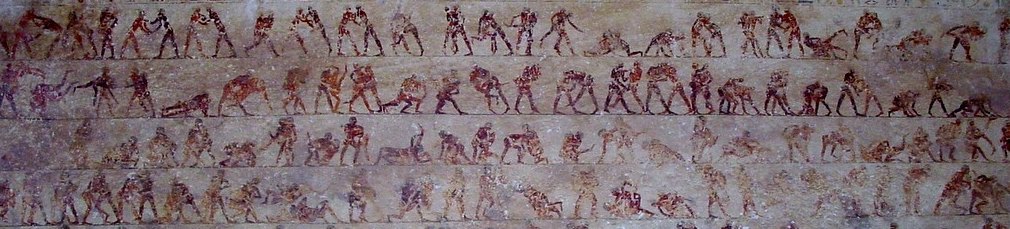
To break this down, framing the terminology will be important, especially given the many misconceptions about what martial arts are, and what martial arts are not. For example, martial arts are not exclusive to Eastern Asia. While Eastern Asia is home to numerous ancient and modern martial arts traditions, the term martial arts applies to any tradition or method of close-quarters combat which prepares the practitioner to enact and/or resist violence in earnest. Martial arts traditions have existed all around the world from the earliest points of human history (some of the earliest depictions of martial arts training date back to ancient Egypt). For colonists in 18th century North America, European martial traditions offered a fertile ground for the continued practice of the Arts of Mars.

Wrestling holds from the tombs at Beni Hasan in Egypt, one of the oldest extant depictions of martial arts in existence.

A complete overview of North American martial arts is well beyond the scope of this article. Instead, we’ll focus on a handful of examples intended to illustrate the diversity of martial arts present in colonial society and the degree to which they were a present part of daily life for many.

We’ll start by looking at hand-to-hand combat in the military. For European armies of the early 18th century, hand-to-hand combat with sword and bayonet was not uncommon, whether storming an enemy fortification or in the grinding, constant garrison duty which filled the majority of a soldier’s life. One of the most famous swordsman of the British army was a Scottish fencing master named Donald McBane, whose military career included side occupation as an instructor of swordsmanship, duelist and prize-fighter, and brothel-owner. North American service had a number of major differences from service in Europe, however. By mid-century, British officers in North America determined that the common soldier had no need of his issued hanger (a short infantry sword, sometimes referred to as a cutlass) when serving in the rough wilderness where mobility and light loads were key to survival and military success. This is often taken to mean that the troops had no need for a sword in general, however many units did continue to be issued hangers while performing garrison duty through the end of the Revolutionary war.


A View of the Church of Notre Dame de la Victoire, Québec, 1759. While
North American soldiers often left their swords behind when going into the
field, those in garrison generally kept them close at hand, as depicted here.

During the buildup to revolution, British troops clashed with angry mobs in the cities of the colonies. Descriptions of these conflicts often mention British troops using their swords to good effect. A highly sensationalized propaganda account of “The Battle of Golden Hill”, which took place on January 19th, 1770 in New York City, describes separatist citizens and British soldiers fighting in the streets armed with sleigh rungs and swords.

The sword was also not the only side-arm of the enlisted man. British and American soldiers were issued a bayonet as part of their stand of arms. This side-arm remained in use even when swords became less common, as it could be fixed on the end of the musket to form a spear-like weapon, held by the socket for employment as a short thrusting sword, or held in a reverse grip by the blade itself (as it was primarily a thrusting weapon, the edges of the spike-bayonet were un-sharpened) for use as a dagger or to apply leverage in grappling in the same manner as a Scottish dirk. On the battlefield itself, the threat of the bayonet charge could be as effective as the physical application of the steel itself, allowing units to gain ground which, once gained, was held through concentrated application of musket fire.

The British were not the only ones who recognized the importance of the bayonet. Washington and other American leaders issued or recommended spears as a substitute for the bayonet when the genuine article was unobtainable. This was especially important in siege warfare, when employing defensive field fortifications, or for defense against cavalry (who were ever poised to ride down disorganized bands of infantry).

These martial traditions were not reserved to the military world by any means. The most familiar form of 18th century martial arts for many people is fencing with the smallsword. The smallsword had a slim blade designed for fine motion and deadly thrusts, even against an opponent clad in the heavy wool and linen clothing of the time. The earliest fencing treatise in North America was by Edward Blackwell, and was published in Williamsburg, Virginia, by a Mr. William Parks. While instructors of swordsmanship were not as common in the colonies as they were in Europe, the cities of the East coast attracted a decent number of masters and would-be-masters, often doing double duty as dance instructors. Still, the most aspiring young swordsmen, including Alexander Hamilton’s friend John Laurens, traveled to Europe to hone their skills.
Images from Sir William Hope's New Method of Fencing, depicting the smallsword in practical use against other swordsmen, in the grapple, on horseback, and even against much heavier weapons such as the Lochaber axe.

Martial skills were not only taught in the refined schools of the colonial cities however. Folk martial arts flourished as well, with traditional wrestling and grappling skills forming part of the upbringing of almost every working-class man. More lethal weaponry found its way into the hands of the citizenry as well. For instance, while the “Boston Massacre” is popularly depicted as a merciless slaughter of unarmed civilians by leering British soldiers, eye-witness testimony and the deposition of actual participants tells a very different story of a crowd armed with clubs, rocks, and even swords. According to Benjamin Burdick, a participant in the riot:

I had in my hand a highland broad Sword which I brought from home. Upon my coming out I was told it was a wrangle between the Soldiers and people, upon that I went back and got my Sword.
I never used to go out with a weapon. I had not my Sword drawn till after the Soldier pushed his Bayonet at me. I should have cut his head off if he had stepd out of his Rank to attack me again.
A mid-18th century highland broadsword similar to the type carried
by 
Benjamin Burdick at "The Boston Massacre".
The use of clubs, walking sticks, and stones as lethal weapons in urban brawls was a well-established part of the European and Colonial martial scene at this point. In his autobiographical Journal of My Life, French apprentice Jacques-Louis Ménétra described massive battles between hundreds of Parisian apprentices armed with canes, rocks, clubs, and in some cases swords, which often resulted in heavy casualties.*

What of the Schuylers? The men of the family, or at least the sons-in-law, are famous for their dueling (both John Barker Church and Alexander Hamilton met with Aaron Burr for duels, with rather different results). Even Philip himself was involved in a duel in May of 1769 while a member of the Provincial Assembly, though the situation was resolved without the loss of life. These duels, however, were all conducted with pistols. However, on February 27th, 1769, Henry Van Schaak of Albany wrote to his brother to describe a fascinating incident involving Philip Schuyler:

The dispute between Col. Schuyler and the brewer Anthony… was briefly this: the latter had said, at the Coffee House, that the aim of the Colonel’s motions in the House was popularity, and added something which I forget. The colonel immediately armed himself with his sword, went to the Coffee House and other public places thus arrayed. I saw him come in this manner into the house of Assembly, ‘tis said in search of Anthony, not meeting with him, he called upon his at his own house where he says he asked his pardon.

Beneath the reserved tone of the letter, what we have here is a description of Philip Schuyler as a man ready and willing to settle slights of honor at sword point (and pistol point that same year). While there is no clear information about Philip’s level of training as a swordsman, his service in the British army would have afforded him the opportunity to achieve a basic appreciation of the handling of such a weapon. While his actions were primarily those of a scorned aristocrat, it appears that 18th century society was martially competent enough to make it unlikely that his threat was an entirely empty one.

We're back with new articles every week as we roll into 2017. There's lots to explore so stay tuned! Have you heard stories about the 18th century or the Schuyler family that make you scratch your head? Know any longstanding myths that you'd like us to take a crack at? Let us know in the comments or on our Facebook page, and your suggestion just might be featured on an upcoming Mansion Mythbusters!

Want to learn more about fencing (specifically as the term applies to swordsmanship) in Colonial America? click here!


*See page 41 for one of the best descriptions of such an affray.