Showing posts with label Ian Mumpton. Show all posts

Saturday, April 1, 2023

Philip Schuyler, the Albany Avenger

It’s that time of year again, when we post our annual April Fools article. In past years, every effort has been made to make these seem strange stories that like they really shouldn’t be true, but where everything seems to line up in a believable enough way. As much fun as that is, it can cause problems from time to time, such as when one reader prepared Philip Schuyler’s “recipe” for bacon-wrapped eels on the grill- a reference that we made up (at least they were tasty!) This year we’ve decided to take a subtly different tack:

The following is not history. At all. Occasionally we may include a historical name or date, but any similarity to any persons living, dead, or undead, is either accidental or used fictitiously to provide a veneer of authenticity so thin it could be marred with a sneeze. So without further delay, allow us to present Philip Schuyler, the Albany Avenger.

The year was 1781. The stakes? Nothing less than the independence of the United States of America. British forces in North America were reeling from a series of key losses, including Cornwallis’s dramatic surrender at Yorktown, and from dwindling support on the home front. Desperate for a stunning victory that would secure their military position in the colonies and inspire political confidence in Britain, top-ranking Crown officers gathered to discuss the seemingly preposterous plan put forward by junior officer and part-time scientist, Lt. Johnathan Hammond of the 42nd Royal Highland regiment, recently returned to England from duty in the Caribbean. Hammond’s proposal was simple-

Dinosaurs.

A 1780 image of dinosaurs being measured and fitted for armor in London.

Admittedly, this was nothing new at that time. The military application of dinosaurs in Europe began with the French in the early 18th century. Prior to their deployment at the Battle of Parc Jurassique in 1711, dinosaurs were a closely kept secret of the French military, but when a thundering herd of enraged ankylosaurs smashed through the Duke of Marlborough’s lines, Britain had quickly begun development of their own saurian military force. By 1775, Britain had deployed dinosaurs in every one of their European conflicts since 1735, as well as against Jacobite forces and Irish revolutionaries closer to home. The pride of British dinodom was William, a 42-foot, 13.5 metric ton Tyrannosaurus Rex known for his brash confidence and dislike of protocol and authority, but who could be relied on to, “get the job done…”.


That this T-Rex would prove a valuable military asset in North America was beyond doubt, but one fact remained that made Hammond’s proposal seem outlandish: no European power had thus far successfully transported a dinosaur across the Atlantic.  Lt. Hammond was confident that it could be done, however, and offered to rapidly design and construct a ship capable of transporting William the T-Rex from Cornwall to New York, a promise he astonishingly made good on. On April 1st, 1782,two-hundred and forty one years ago today, Hammond’s vessel, HMS Ingenuity dropped anchor in the harbor of New York City with William safely aboard. The cost of transportation had been staggering. For sustenance William had consumed a total of 112 head of cattle and 45 tunns of rum (11,340 gallons) on the voyage, while four sailors spent the entire crossing earning special duty pay to ensure the removal of his waste in a timely fashion.

Actor Jeff Goldblum (best known for his roles
in movies such as The Fly (1986) and Cats and Dogs (2001))
as Dr. Johnathan Malcom in the 1993 film In-Dino-Pendance Day.
While panned for its inaccurate costuming, the film
offers a gripping retelling of the 1782 Battle of Fishkill.

The cost was worth it, however, when William stomped ashore. One local citizen, Dr. John Malcom,
described the sight of the gigantic creature making its way through the city in a letter to a friend, saying “It was by far the most marvelous and terrifying sight I have ever beheld, a monstrous lizard some forty feet in length. Everyone watched in horrified awe as it passed, anxiously exposing themselves to its gaze, out of trepidation that such a marvel should pass so close to their lives and them not to see it.” The crowds were so dense that Malcom’s wife, Sarah, was unable to see William through the masses. According to Dr. Malcom, “many were too preoccupied with the question of how they might get a closer view that none thought to question whether they ought to. My wife being amongst these, was dissatisfied with her vantage point, and resolved to get closer. The crowd was so numerous that this seemed impossible, but as is ever the case, [my] wife found a way…”

Six days later, Continental forces near Fishkill were awakened at dawn by the thunderous roar of a creature most had never imagined existing, much less anticipated facing in battle. Fitted with armor made up of interlocking plates and chainmail, William tore through their defenses, devouring all in his path. Musket fire was virtually useless against William, and even field artillery was ill equipped to handle the speed with which this King of the Late Cretaceous rampaged across the battlefield. Only cavalry had the mobility necessary to match him. While their weaponry was unable to pose significant threat to William’s armored bulk, a small unit of riders under the command of Captain Enoch Otiss managed to draw the attention of the dinosaur long enough for their comrades to organize a tactical withdrawal. With British troops advancing, things looked grim for the Continental forces.

Enter Philip Schuyler. While he no longer held a commission in the Continental Army, the former Major General was still very much an active participant in the conflict. Schuyler had an expansive roster of contacts and spies throughout New York. In fact, he had been tracking the Ingenuity’s progress from England, and had been made aware of William’s presence in North America several days before the attack at Fishkill! On April 3rd, 1782, Schuyler received a message from an as-yet unidentified “D. Nedry of Lansingburgh” that read simply:

Hgrubgnisnal ,yrden D

,yllaicnanif sryY.

daer si regneva ynabla eht yarp i. Emoc sah mailliw. Deraef ew sa si ti,

Lareneg raed

Despite being apparent gibberish, the message was actually an encoded warning! According to Schuyler Mansion Historic Site Assistant Ian Mumpton, “Nedry ensured the secrecy of his warning by employing what is known as a non-substitutive, mono-alphabetic reversion cipher, also known as ‘writing it backwards’. This type of encryption, really, if were to ask me, was very bad.”

Through careful examination in a mirror, it was determined that Nedry’s message to Schuyler was as follows:

Dear General,

It is as we feared. William has come. I pray the Albany Avenger is ready.

Yrs. Financially,
D. Nedry, Lansingburgh.

Schuyler had long known that conventional military resources would be ineffective against militarily trained and equipped dinosaurs. While most of the Revolutionary leadership dismissed the possibility that Britain would be able to transport saurian shock troops across the Atlantic, Schuyler’s concerns were shared by Dr. Benjamin Franklin and Tadeusz Kościuszko, a Polish engineer and officer serving in the Continental Army. As early as 1777, the three had begun plans for what Nedry referred to in his letter as “The Albany Avenger”.

A contemporary depiction of the Albany Avenger under construction,
by Albany artist FaeganMorheart.

‘What was the Albany Avenger?’ you might ask (as well you should). Built of woven ash-wood and willow around an articulated iron frame by a team of 200 Albany laborers (under the careful supervision of General Kościuszko), and powered by Franklin’s research on the application of electrical energy, the Albany Avenger stood 40 feet tall, “Like in form to a man, but of much Greater Scale, and its strength proportionate- the very thing to drive the great Lizard of London from our fair and abundant shores!”  According to Schuyler, “It is the protector of the Hudson now, but when it has been the instrument of our National Liberty and salvation, it shall be known as the Colossus of America!” Philip Schuyler’s contribution to the effort, beyond offsetting the monumental financial resources needed, was one which would guarantee his place in the halls of “history” for all time. The former Major General volunteered himself as the pilot of this incredible 18th century combat exoskeleton.

And so, on morning of April 7th, 1782, the stage was set for the ultimate showdown between William, the largest Tyrannosaurus Rex in the service of His Majesty, King George III of England, and Philip Schuyler, aka The Albany Avenger. Much has been written about that fateful battle, and it would be repetitive to describe it in detail here. We all know that Schuyler emerged victorious; we have all heard the legends of the bees and the apples, and of the noble sacrifice of Jim Adams (who, if not for his role at Fishkill, would be the least famous of the three Adamses of the Revolution). But the story known to far fewer, is what happened to Lt. Hammond and William after their defeat.

According to recent research made up by Schuyler Mansion staff, when the British government decided, after careful consideration, not to endorse another saurian expedition to North America, Lt. Hammond resigned his commission in frustration and disgrace. Returning to the Caribbean, he joined with other investors investing in amber mines. William, incensed by the treatment of his friend, similarly resigned, devouring two generals in the process. He attempted to make a name for himself in the world of pugilism. Sadly, though he reigned uncontested in rural “all in” matches, his lack of reach hindered his success in formal fights, and William retired to live with his sister Susan in Liverpool in 1789.

An undated depiction of William facing off against British bareknuckle champion Tom Johnson.

Tuesday, February 21, 2023

Peruvian Bark and Turlington's Balsam: Uncovering the Medical History of the Enslaved at Schuyler Mansion

17th century Colonial personification
of Peru offering Cinchona to Science.
Cinchona became a staple medicinal
resource for European colonial
empires for a nearly 300 years.
By Ian Mumpton

On a bitterly cold February day in 1776, a man named Prince sat in a freezing cell in Albany, preparing a letter to Catharine Schuyler as frostbite gnawed at his feet. In this letter, Prince described his situation, reporting that he had “quite lost the use of my limbs with cold” after a forced march from Canada over the preceding winter. Prince was eventually purchased by the Schuyler family, but staff at Schuyler Mansion have often wondered about the long-term impact of that winter imprisonment on Prince’s health. Was he fortunate enough to make a full recovery? Or, more likely, did the harm he endured affect his health and mobility for the rest of his life?

While Prince’s letter is a vivid, personal statement about his situation in February of 1776, evidence about his later condition can be found in a far more mundane source: a medical bill from Dr. Samuel Stringer for treatments rendered to members of the Schuyler family and household between January and December of 1787.[1] During that year, Prince was among the ten enslaved servants mentioned, and was treated at least five times between January and June.  Most of the medicines described included some variety of either “Peruvian Bark” (Cinchona) , “Balsam of Peru” (Myroxylon pereirae), or both. Both were often prescribed for fevers or as an antidote to ingested poisons, but were noted as effective treatments for joint pain and rashes.[2] Furthermore, after prescribing these medicines on February 12th, Dr. Stringer charged £4 on April 29th for “dressing Princes [sic] leg from the 12th Feb to this day inclusive.” While we may never know if this was an isolated flair of leg pain, or a documented glimpse of a more chronic disability, receipts like this allow us shed important light on the medical history of other people enslaved by the Schuylers as well, by examining their recorded symptoms and the treatments they received. For example, a man named Dick is mentioned three times in the same receipt, each time having received the exact same treatment—a bottle of Turlington’s Balsam at a cost of 8 shillings.

Peru Balsam 

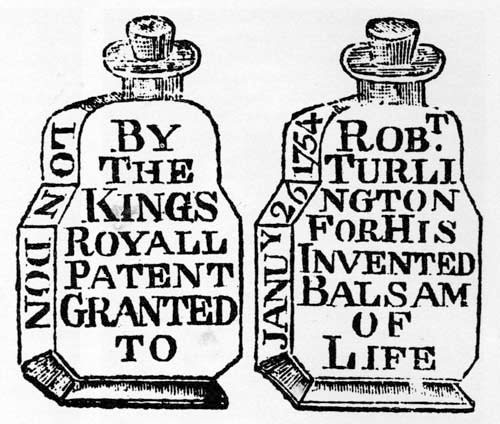
Robert Turlington patented his “Balsam of Life” in 1744.[3] Despite having no documentable medical experience, he insisted that his medicine treated a wide
range of conditions, including kidney issues and “inward weaknesses” or ruptures (what we would today call hernias). While Turlington’s Balsam was supposedly a near-miraculous cure-all, Dr. Stringer almost certainly prescribed it to Dick for chronic hernias (likely the result of decades of constant heavy-lifting as a cartman for the Schuylers). Dick had dealt with hernias for at least four years at that point, as evidenced by a 1783 letter from Philip Schuyler to Stephan Van Rensselaer in which Schuyler wrote “Be so good as to advise me if Dick is likely soon to be better of the rupture which troubles him.”[4] While a popular treatment, there is little evidence of the efficacy of Turlington’s Balsam, and there are currently no identified references to Dick after November 19th of 1787.

Several other enslaved men besides Prince and Dick are mentioned in Dr. Stringer’s receipt: Peter, Jacob, Cato, and Jim. Like Dick, these men are all documented as driving carts and hauling supplies for the Schuyler family. They would have worked long hours with heavy loads in all sorts of weather, and this labor is reflected in the medical treatments they received. Jacob, Peter, and Cato were all prescribed something that Dr. Stringer recorded as “Linam: Sapon”, most likely liniment sapo[5], a compound of soap and camphor considered useful in treating joint pain and spasms, as well as blisters and sunburns. Jim was likewise treated with a zinc and castor compound, used to this day to treat rashes, skin abrasions, and burned or heavily chapped skin.

It is important to note how infrequently these men were treated for the myriad fevers, agues, and other illnesses that the Schuyler family received care for. While they certainly would have contracted those with the same frequency as any other individual of their time period, Philip Schuyler was far more likely to lay out money to treat the leg and joint injuries, saddle-rashes, and hernias caused by their labor— the injuries which stood to reduce the amount of profitable labor he could extract from them.

Turlington's Balsam of Life bottles as
represented in a brochure dated 1755–1757.
The receipt also mentions two women enslaved by the Schuylers: Moll and Britt. While we have not yet been able to determine what Moll’s treatment was (or what condition it was intended to treat), Britt was prescribed the same liniment sapo as the cartmen, as well as camphor gum (similarly used to treat spasms and joint pain).[6] As women’s work in the period tended toward repetitive movements and joint strain with tasks like cooking, hauling water and firewood, sewing and textile production, and childcare, this may reflect treatment for repetitive motion injuries. However, it is also possible that Britt’s treatment was due to complications during pregnancy. In addition to the camphor soap and gum, on April 17th, 1787, Britt was prescribed ginger, which folk tradition has long held can help induce labor. Shortly after, on June 16th, Dr. Stringer charged the Schuyler family 2 shillings for providing magnesia alba (a stomach soothing antacid popular for infants)[7] to “Britts child”! He would provide the same again on September 18th of the same year.[8]

While Britt may have received her medical attention from Dr. Stringer, the Schuyler family’s personal physician, other women enslaved by the Schuylers would have tended to their own obstetric care or relied on the care of other women. These may have been trained midwives, or simply other women with only their own or relatives’ experience to guide them.  In 1768, the Schuylers credited a “Miss Van Den Werken” one pound, three shillings at their store for “…taking care of Hannah the Wench when in labour”.[9]

Dr. Stringer was not the only doctor to provide medical treatment for the enslaved servants of the Schuyler family. Between August of 1757 and August of 1764, Dr. Henry Van Dyke was called upon to provide medical care for two unnamed servants, a man and woman, bound to the Schuylers.[10] The woman was treated with unspecified medicines between the 26th of August and the 12th of September, while the following February the unnamed man required “dressing and salve” for his leg. In August of 1764, Dr. Van Dyke treated an enslaved man named Mink by “bleeding & a dose of Physic”, likely for a fever or inflammation.

While none of their receipt descriptions paints a full picture by itself, the details revealed add dimension and depth to our understanding of the lives of the men, women, and children enslaved by the Schuylers. Placed in the context of what else we are learning about the enslaved, the terse lines of numbers and medical abbreviations allows us to envision Jim and Peter rubbing camphor soaps onto aching joints after a long day of transporting hay and apples for Philip Schuyler, talking about Jim’s plan to buy his freedom and move his family to Easton, while Britt soothes her little one’s upset stomach with a dose of magnesia alba.

Follow our continuing efforts to uncover the lives of the nearly seventy individuals enslaved at Schuyler Mansion here on this blog, and through our social media on Facebook, Twitter, and Instagram!


[1] Receipt for Medical Services from Dr. Samuel Stringer to Philip Schuyler, Schuyler Papers, NYPL, Reel 2, Box 3.

[2] Glossary of Drugs Prescribed or Dispensed in Colonial New England  https://www.colonialsociety.org/node/1218

[3] Jones, Olive and Vegotsky, Allen (2016) "Turlington’s Balsam of Life," Northeast Historical Archaeology: Vol. 45 45, Article 1. https://orb.binghamton.edu/neha/vol45/iss1/1

[4] Philip Schuyler to Stephan VR, July 10, 1783. Slavery and Enslaved People at Schuyler Mansion

[5] Glossary of Drugs Prescribed or Dispensed in Colonial New England  https://www.colonialsociety.org/node/1218

[6] Glossary of Drugs Prescribed or Dispensed in Colonial New England  https://www.colonialsociety.org/node/1218

[7] Glossary of Drugs Prescribed or Dispensed in Colonial New England  https://www.colonialsociety.org/node/1218

[8] Receipt for Medical Services from Dr. Samuel Stringer to Philip Schuyler, Schuyler Papers, NYPL, Reel 2, Box 3.

[9] Philip Schuyler Saratoga Daybook 1764-1770, NYHS.

[10] Receipt for Medical Services from Dr. Henry Van Dyke to Philip Schuyler 1755-1764, Sleepy Hollow Restoration, S-966.

Friday, January 6, 2023

Holidays in Colonial New York

By Ian Mumpton

There are well over a dozen holidays celebrated between December and January worldwide, but if we were to time-travel to colonial Albany, what festivities might we partake in? Well, that depends on who you were celebrating with!

In the 17th and 18th centuries, this region was home to a multitude of national, cultural, and spiritual holiday traditions. In December, people of the Six Nations of the Haudenosaunee celebrated the End of Seasons and prepared for the Midwinter Rites in January- a time for renewing the relationships and responsibilities with their communities and with the earth as the year began anew. Likewise in January, Mahicans observed the New Year with the Bear Sacrifice ceremony and hopes for a bountiful sap season to come.

European Christian colonists, both Protestant and Catholic, observed a panoply of secular and religious traditions from the Netherlands, England, Scotland, France, Ireland, Germany, Denmark, Sweden, Wales, Spain, Portugal, Switzerland, Austria, Croatia, and beyond, as well as new traditions born in the colonies. This included not only Christmas Day, but the Feast of St. Nicholas for the Dutch, Epiphany (also called Twelfth Night), and a variety of New Years’ celebrations.

While largely prohibited from public observance, Jewish colonists (mostly Sephardim and Ashkenazim) were part of the community since the late 1650s would have observed Chanukah within their own homes by lighting oil menorahs, making sufgonyot (oil cake donuts) and singing songs such as Al Hanissim (“On the Miracles”) and Ma'oz Tzur (“Refuge, Rock of my Salvation”, commonly known today as “Rock of Ages”). 

Enslaved and free Africans brought with them traditions from Ghana, Dahomey, the Kingdom of Kongo, and beyond. Some were from Christian communities in Africa, while some others converted in the colonies, and would have marked Christmas as a religious holiday. Others were Muslim and may have commemorated Islamic holidays in December or January when the Islamic and European calendars aligned.

With so many overlapping traditions interacting in a relatively small community, many groups were influenced by the celebrations of others, especially when it came to secular aspects of their revelry! What about the Schuylers? While there are surprisingly few references to the holidays in their documents, we can get a general idea from by looking at how others in the community celebrated, and at letters between family members. 

The Schuyler family was of Dutch descent. They were part of a large kin group of powerful Dutch families, the parents spoke Dutch at home growing up (as did at least their older children), and they attended the Dutch Reformed Church in Albany. In this Protestant Dutch tradition, Christmas itself was observed as a quiet, often somber, holy day preceding the more raucous festivities of New Years and Epiphany. Even as the Schuylers adopted more and more English cultural expressions in the 1760s forward, Christmas day may have taken on a more festive air, but English tradition still emphasized the weeks after the 25th of December as the best time for revelry.

While others on the community may have partied it up on New Years, however, family correspondence suggests that the Schuylers saved their big celebration until still later in the holiday season. Philip Schuyler wrote to Alexander Hamilton on January 2nd, 1802, to inform him that “My Coachman Toby is very Much Indisposed. My other Servants abroad on their holyday frolick [sic], that I can only send Anthony to morrow [sic] morning[.]” From this letter, it appears that the Schuylers participated in the custom of giving the people they enslaved time at New Years to gather and celebrate with friends and family. With only two servants remaining in the household, one of them ill, it is highly unlikely that the status-conscious Schuyler family intended any sort of major celebration on New Years or the days immediately after, at least by this time.

If the Schuylers did throw a big party, it was most likely for Epiphany (also known as Twelfth Night). Both Dutch and English traditions held this as time for music, food, and togetherness, as well as lively (often chaotic) celebration.  It was also a time for the wealthy to show their largesse to friend and stranger alike. What would Twelfth Night look like in the Schuylers’ home? Well, come visit us on Saturday, January 7th, between 4PM-7PM and see for yourself!

Friday, April 1, 2022

"The Noble North American Groundhog": Philip Schuyler's Underappreciated Engineering Inspiration

The guffaws of neither gentlemen of Agriculture nor polite Society, will ever shake me from my maintenance that the creature most Worth[y] of emulation & praise is the Noble north American Ground Hog.                                                                                                  -Philip Schuyler, to John Cadwalader, November 6th, 1785


A groundhog, or woodchuck, outside of its burrow in Quebec.

While best-known as a general and politician, Philip Schuyler’s primary occupation over the course of his life was that of the “gentleman farmer”. Though he seldom labored in the fields himself, much of his time was taken up with the management of thousands of acres of farmland, the transport and sale of crops from that land, and the pursuit of more sophisticated scientific approaches to agriculture. It can be surprising to learn, therefore, that Schuyler could speak so highly of the North American woodchuck, or groundhog. And yet, the generational feud that has existed between farmers and groundhogs since the first crop was planted in North America notwithstanding, for Philip Schuyler, this creature held a fascination bordering on obsession.

In 1785, just as Cadwalader was helping to found the Philadelphia Society for the Promotion of Agriculture and Agricultural Reform, Philip Schuyler penned the words above. He went on to explain his appreciation of the groundhog, saying: 

Cadwalader and family, by Charles Wilson Peale
The greatest agrarian minds in New York, Pennsylvania, Maryland, and elsewhere have sought to best the groundhog, to no avail, and though they rant and rave to the point of apoplexy at the depredations done by this denizen of our fields and forests, neither the most inspired creations of their minds, nor the furor of all their vented spleen can scarce suffice to protect a single lettuce should this furred artificer of the soil select it for consumption... In their mannerisms they are neat and tidy, practicing good grooming and washing their faces in like manner to squirrels, cats, and rakecoons [sic] and the better sort of persons. They are as attentive to their young as the most doting parent, and cooperate with one another in the industrious construction of their sprawling domiciles or dens. Their patient procurement of foodstuffs against the harsh winter months ought be a measured example to the young and reckless Farmer who seeks to sell all he may with no thought to laying by a stock against want or poor markets, and their coats are markable [sic] soft and warm for a creature that lives so much of its life in the soil - more so than musk rats [sic], though not so suitable for hats as beaver when it was more plentiful. In short, while they may plague our crops and frustrate our ambitions at every turn, the ground hog is better regarded as a Teacher to men such as ourselves, rather than an Adversary.

Despite Schuyler’s reputation as a respected farm manager himself, Cadwalader was unconvinced, and said so to fellow progressive agriculturalist, George Logan in a letter just a few weeks later, on November 23rd:

…I have received another letter from Ph. Scuyler [sic] at Albany on the subject of Ground Hogs. I own the man is a self-taught genius on many matters relating to our Fields -should you pardon my punning- but to hear him write so much on the subject of this garden posst [sic- pest] strains credulity. How can this be the same man whose flax mills garner such praise?

From this letter, it seems that this was not the first time Schuyler had expounded upon the qualities of the woodchuck. In fact, evidence of his interest in the creature can be traced back to the 1750’s at least. According to Schuyler Mansion site director Heidi Hill, “Philip Schuyler long marveled over the engineering prowess of the groundhogs of NYS…first taking note of the groundhog’s genius as it relates to root and bolder support and bearing weight in an elaborate maze of woodchuck dens he discovered near Lake Oneida while stationed there during the French and Indian conflict.”

Philip Schuyler's proposed plan for the use of 
tunnels to seize French food supplies from the
storehouse, bakery, and gardens at Frontenac
as outlined on a British map of the fort.
Further evidence of his appreciation can likewise be traced to his early military service in a letter from Schuyler to his mentor, John Bradstreet. Bradstreet was one of the leading British military officers in North America. In 1758, Bradstreet was attempting to capture the vital French fortification at Frontenac, near modern day Kingston, Ontario. In laying plans for the anticipated siege, Philip Schuyler apparently looked to woodchucks for inspiration once again, suggesting that, “...should the French prove firm in their defense, hunger has a way of breaking men of their resolve. I propose that a team of sappers be employed at good rates as to instill a sense of expedition in them, that they might dig under the walls of the fortress and, locating the French food supplies, make off with them, as does the wily ground hog or, as the French in Canada call it, the siffleux.

Bradstreet, however, elected not to take his protégé’s advice in this case, replying, “as to the ground hog plan, we have neither the men nor the time to undertake such a digging, and if we had, what cause would I have not to simply send in soldiers to effect a capture through these tunnels? I suggest we look to another animal for our guide in this matter, perhaps I might suggest a more martial creature?” Fortunately for the British, following a well-orchestrated campaign, Frontenac surrendered after a two-day siege.

Recently, further evidence has been found in Schuyler’s original plans for the construction of his Albany mansion. Visitors often ask if Philip Schuyler had a secret escape tunnel leading out of the home, in case of attack. While there is no evidence that it was ever constructed, his early notes on the project include a letter to his friend Abraham Ten Broeck in which Schuyler wrote, “As for the matter of selecting a plot upon which to situate the House I intend, it is best it be atop a hill, with a good view of the river, plenty of cultivatable land about it, and perhaps a stream for maintaining a mill. The soil must needs be firm enough for reliable construction, but not so stony as to preclude the digging of passages such as we have spoken of.”

It has always been assumed that the “passages” he referred to were for storage or some sort of unspecified industrial application, however, in January of 2022, archivists Jan Mack and Allan Dyssop found documents that radically altered our understanding of the process of designing the home: Philip Schuyler’s original, hand-sketched blueprints for what would become Schuyler Mansion. What they saw was surprising, to say the least!

According to Mack and Dyssop, “Philip Schuyler likely drafted these plans well before ever purchasing the plot of land on the hill overlooking the Dutch Reformed Church’s pastureland, so it is unsurprising that it differs significantly from the ultimate construction. The most notable change, however, really took us off guard. As you can see from the lines radiating off of the sides of the house, it appears that Schuyler saw his home as the hub of a vast system of underground tunnels connecting him to various locations in the city of Albany and the surrounding area. From his notes on the paper, it appears that his inspiration for this design was the burrow pattern of a woodchuck or groundhog.”[1]

Philip Schuyler's early vision for his estate, complete with groundhog-inspired subterranean passageways. The eventual construction was moved to the south side of the Beaverkill (shown at left), and the tunnel-plan was abandoned.
The locations connected by the tunnel system include the Dutch Church, Schuyler’s mother’s house, and the home of his friend Abraham Ten Broeck. While there are still many questions to answer, staff at Schuyler Mansion are excited. “This is just incredible,” says Ian Mumpton, historic site assistant, “I mean this is literally incredible information.”

Today is April 1st, meaning reservations are now available for our April tour dates. Check out our Facebook page for more information about visiting the site this month, and we will hope to see you soon!


**********

Happy April Fools!

Yes, it’s that time again where we make stuff up, but as usual, the prank article contains references to plenty of fascinating real history! So, what's real?

To start with, Schuyler, Cadwalader, and Morgan were all prominent agriculturalists of their day, and leaders in the post-Revolutionary War effort to modernize and expand scientific agriculture in the early United States republic. You can learn more about the formation of the Philadelphia Society for the Promotion of Agriculture here and explore sources related to it here. You can also click here for sources about the New York Society for the Promotion of Agriculture, Arts, and Manufactures, the origin of the Albany Institute of History and Art. Founded in New York City in 1791, the organization moved from NYC to Albany in 1797, and their history is closely connected to the Schuyler family and the mansion! Similarly, Schuyler’s flax mills really were a key part of his agricultural empire, and garnered praise and awards in their day. (Check back soon for an article about the exhibit expansion currently in the works, that will include an opportunity for visitors to “talk” with a tenant laborer about what work was like in the flax mill!)

While Schuyler did not propose groundhog-related stratagems to his commander during the French and Indian war, he did serve with distinction under Bradstreet, and was involved in the logistics of military operations against the French colonial empire in Canada. He did traverse Oneida lake en-route to Oswego, and was involved in the campaign to capture of Frontenac. He knew the importance of supply lines intimately, and was well aware of how precarious an operation or defense could become without food! The map of Frontenac shown is real as well and can be viewed here (minus the added groundhog tunnels of course), courtesy of the Massachusetts Historical Society. The same source also includes maps of the defenses built at Oneida lake during the conflict, as well as Forts Stanwix, Ticonderoga, and Ontario, Schenectady and Albany, and many other locations Schuyler visited over the course of his service in the French and Indian war and the Revolution.

As we noted last year, Schuyler was close friends with Abraham Ten Broeck, and talked with him about many of his plans over the course of his life. “Brahm” was likely Philip’s closest friend, besides his wife Catharine, and had Philip intended to build a woodchuck warren beneath his mansion, would almost certainly have been roped into the plan. As it is, the thought of Philip Schuyler and his best friend sneaking off to the coffeehouse together through their secret tunnel must be written off as the product of an overactive imagination.

As some folks caught, we were “making this up” with archivist authors Mack and Dyssop. Similarly their editor, Anne Notherpun is another pun, and their publisher is in fact, not a real press (and therefore not located in the Pennsylvania town universally associated with Groundhog’sDay in the US). But while the names were nothing more than fun wordplay, the uncovering of old documents capable of shedding new light on old ideas is very real, and very topical, here at Schuyler Mansion. Whether through newly acquired or discovered documents, revisiting old sources with fresh eyes, or good old-fashioned historical sleuthing in pursuit of answers to new questions, we a constantly learning new information about the people whose histories are intertwined with Schuyler mansion. In fact, “What’s New?” is the theme for our social media this month. Be sure to follow us on Twitter, Facebook, and Instagram to hear out about new discoveries, get the scoop on cutting edge research, and sneak a peek at upcoming exhibit content still in development!

As always, thank you to everyone who played along with our tradition. And remember, it is important to keep an open mind when exploring the past, because the truth is sometimes weirder than the fiction, but always make sure to check your sources, especially is the information seems particularly… incredible!


[1] Mack, Jan, and Allan Dyssop. 2022. An Archival Analysis of Documents Relating to the Construction of Schuyler Mansion. Edited by Anne Notherpun. Punxsutawney, PA: Knott Ariel Press.


Thursday, April 1, 2021

A Hundred Leagues I’d Walk to My Love: Philip Schuyler’s Musical Courtship of Catharine van Rensselaer

***The article that follows was written as Schuyler Mansion's annual April Fools post. Unfortunately, Philip Schuyler did not write the music that would eventually become "I'm Gonna Be (500 Miles)". Thank you to everyone who played along!***


“But I would walk 500 miles And I would walk 500 more just to be the man who walked a 1000 miles to fall down at your door!” With the rhythmic guitar, heartfelt lyrics, and captivating Scottish accents, who can resist the Proclaimers 1988 hit “I’m Gonna Be”, better known in the US as “500 Miles”? But did you know that the Reid brothers found their inspiration for the song in a piece written by an earlier composer? As it turns out, this composer was none other than our very own Philip Schuyler!

Cover art of the 1988 album Sunshine on Leith,
which included the hit "I'm Gonna Be".
It can be jarring to think of the stern, aristocratic Philip Schuyler as a young musical heartthrob, but letters from Philip’s late teenage years indicate that he briefly took up music, not as a career, but as a way to win the love of the beautiful and elegant Miss Catharine van Rensselaer, or, as Philip referred to her in a letter to his friend Abraham Ten Broeck, “Sweet Kitty VR”. In fact, it was while pining for “Sweet Kitty” during a trip to Quebec that Philip composed a musical arrangement he titled “A Hundred Leagues I’ll Walk for My Love”.

The first evidence of this song comes from a letter written by Schuyler to Abraham Ten Broeck. While the date on the letter is illegible, it must have been written on a trip to Quebec Philip took prior to the outbreak of the French and Indian, or Seven Years, war, likely in 1753. There to discuss a potential business arrangement with Scottish merchant Angus McGonagle (himself no stranger to musical performance), the young man found his mind focused more on romance than finance.


My Dear Brahm;
 
Matters here progress but so slowly that I fear it will be two weeks more be fore [sic] I return to Albany. I am whistful [sic] for your companionship and all our happy company there. I trust you will not think that I undervalue our friendship tho if I tell you that my mind and heart turn moment after moment to a certain young lady, the identity of whom I am certain you will guess at. You must not laugh at me Brahm to hear that I have put those thoughts of her into music, thoughts that I might demonstrate the fondness of my heart for hers by walking, without pause, the full hundred leagues and more between us, resting only when I fall down at her door. But music on paper cannot compair [sic] to music on the ear, and so I hope that you will accompany me on your violoncello, along with our two friends so we make a quartet. I esteem my self a poor composer, but I hope that this will make my affections for her evident in ways mere words cannot…

 Philip included the sheet music with his letter; an arrangement for violins, viola, and cello, that has a very familiar sound to it. We do not know if he, Abraham, and their unnamed friends ever ended up performing for Catharine, but not long after this letter was sent, Philip and Catharine were married, and had their first child, Angelica, just five months later. The sparks of romance were definitely bright for these two!
Philip and Catharine Schuyler in later life


According to music historian Dr. Emma Jennery, Craig and Charlie Reid ran across Philip's letter and music in late 1987 in a book about Scottish musicians (in relation to Angus McGonagle's career). As explained by Dr. Jennery in an unrecorded broadcast for BBC Scotland, “Craig and Charlie so often tap into the confluence of place and emotion, drawing on timeless inspiration and interpreting it through their iconic sound. They knew they had something there, with Philip Schuyler’s evocative phrasing about wanting to walk that hundred leagues from Quebec to Albany (the one on New York that is), only to fall down at her [Catharine’s] door. They gave his composition the lyrics it deserved and presented it for a modern audience.” Click here to listen to the Wedding String Quartet perform their rendition of “A Hundred Leagues I’d Walk to My Love”, known to the world today as “I’m Gonna Be (500 Miles)”

****************************************************************************

Happy April Fools! As you might have guessed, Philip Schuyler is not the composer behind the Proclaimer's hit, but at least you have it playing through your head again? As is tradition for us, however, we put a lot of real historical content and references into the post. The inspiration for the whole thing came from a letter that Philip Schuyler wrote to his daughter Elizabeth in 1799, in which he made reference to youthful dancing and strolls around Albany.

Abraham Ten Broeck and Philip Schuyler really were childhood friends who maintained a closeness throughout their adult lives. Philip was even initially buried in the Ten Broeck family vault in 1804. The "possible date" for the letter was chosen based on when young Ten Broeck would have returned from a year-long trip to Europe in 1752, and the outbreak of the French and Indian War, or Seven Years War, in 1754. Philip did write to Ten Broeck often, and the reference to "Sweet Kitty VR" comes directly from one of their real-life letters.

So far, there is no known evidence for Philip Schuyler possessing much musical talent or ability, but he certainly encouraged it in his children, especially as part of his daughters' educations. Eliza and Caty are both noted for their skill on the pianoforte, some of their brothers played the flute, and Angelica is believed to have played the parlor guitar. Quartet arrangements were popular in the 1750's, in large part due to the work of composer Joseph Haydn (himself only a year older than Philip). While Philip did not (as far as we know) compose or play music to woo Catharine, the dancing reference in his letter to Elizabeth has been read as an allusion to his early courtship of Catharine. In either case, their relationship does seem to have been as passionate as described here- Philip included frequent attestations of affection in correspondence, and Angelica's birthdate fell well shy of the nine-month-mark from her parents' wedding date.

While Philip Schuyler never did business with Angus McGonagle, the argyle gargoyle who gargles Gershwin gorgeously in season 4 of the Muppet Show, he did work from a young age to develop a broad network of mercantile contacts, both locally and farther afield. This would include trips to Canada throughout his life, as well as New York City, and even a trans-Atlantic voyage to England and Ireland less than a decade after this supposed letter was sent.

Lastly, Dr. Emma Jennery is, in fact, imaginary, but her description of the Proclaimers' music is accurate- many of their songs use emotionally evocative language tied to a specific place or community to tell a story of longing for home and loved ones far away. Year round, staff at Schuyler Mansion are committed to telling all of the many stories that make up our site, both the more familiar ones of the Schuyler family, and those that have received less attention in the past. This commitment to sharing a fuller narrative is apparently something that we share with the Proclaimers as well!

So thanks for reading, and remember...

Friday, February 26, 2021

The Humble Petition of Prince: Navigating Agency Within Enslavement

 By Ian Mumpton

The following article was written following new research on Prince, conducted in 2020 during NYS On PAUSE. As much as staff at Schuyler Mansion are dedicated to, and enjoy, offering engaging public programming, NYS On PAUSE not only helped ensure the safety of visitors and staff, but afforded us the opportunity to dig deeper into the rich, complex history of this site and the people who were here.

 *    *    *

Prince as portrayed in a video
in the Schuyler Mansion
Visitors Center
Of the more than forty people of African descent enslaved by Philip and Catharine Schuyler, a man named Prince has, for many years, held prominence in the interpretation of slavery and the enslaved at Schuyler Mansion. This is due, in large part, to the fact that the details of his life during the time he was enslaved by the Schuylers are better documented than are those of most of the other men, women, and children the Schuylers enslaved. He is regularly mentioned in the personal correspondence of the family, and even served as a common reference point for Philip Schuyler and John Jay when the two used his name as the key to decrypting their encoded messages during the Revolutionary War.

Yet as much his name has stood out in the documentary record, Prince has been the subject of far more questions than answers. One of the most basic of these is how did he end up enslaved in Albany in the first place? Despite a series of letters detailing the specifics of the financial transaction that led to his enslavement by the Schuylers, it is only recently that a fuller picture of his story and situation have emerged.

Prior to enslavement by the Schuylers, Prince was enslaved by a Mr. Alexander MacCulloch. MacCulloch was not your common businessman, rather, he was the Deputy Quartermaster General of Quebec, an important player in the British war effort. While Prince is not, to our current knowledge, documented prior to his arrival in Albany, we can trace Prince’s story and his path to Albany through his much better-documented enslaver.

The autumn of 1775 was one of high hopes for Major General Philip Schuyler, as the forces of the Northern Department prepared to secure British positions at Saint-Jean, Montreal, and Quebec. In late October, Fort Chambly fell to the rebels, along with ninety prisoners of war. Among them was Commissary MacCulloch, who joined other “Men of Rank in Canada”, as described by General Montgomery following the surrender of Saint-Jean, as a prisoner of the Continentals.

Fort Chambly in 1863, William Notman (1826-1891)

Prince’s presence with MacCulloch on the front lines of the conflict can give us insights into Prince as an individual. The services Prince performed for MacCulloch were important enough to MacCulloch that he considered Prince’s presence at the fort essential. Prince was likely a personal attendant to MacCulloch, assisting him with travel, dress and hygiene, and possibly even some secretarial work. Later, Prince seems to have been in close attendance upon Philip Schuyler in a similar capacity, and suggestions of Prince’s literacy can be found throughout Schuyler documents, including a 1791 letter in which Philip indicates that Prince may have reviewed the letter and reminded him to request boards from his son, John Bradstreet Schuyler.

His connection to a prominent military figure and businessman in Quebec raises the possibility that Prince was at least bilingual. His birthplace is unrecorded, but if he was born in Africa, as an adult he may have spoken one or more African languages, and/or possibly Arabic. We know from later sources that Prince spoke fluent English, but he might have spoken French as well. Whether he was born in Africa, the Caribbean, or in Quebec itself, he could easily have been exposed to French at a young age. This skill would have made him especially useful to MacCulloch, given the number of both English-speakers and French-speakers in MacCulloch’s social and professional interactions in Quebec. Philip Schuyler himself considered fluency in French an essential social and professional accomplishment.

American General Washington and valet William Lee
near the Hudson River
- John Trumbull, 1780

Prince’s presence at Chambly is also a reminder of the agency denied to the enslaved. Prince went anywhere MacCulloch ordered—even into a warzone. A similar scenario would take place in 1777, when Philip Schuyler sent a man named Tom and another unnamed enslaved servant to sift through the ashes of his Saratoga estate for iron, while skirmishing fire was still being exchanged between Crown and Separatist forces following the Battles of Saratoga. John Trumbull's portrait of George Washington at West Point included a portrait of Washington's enslaved valet, William Lee, who accompanied the general throughout the Revolution.


By the end of December 1775, the campaign into Canada was rapidly crumbling, and Revolutionary forces slowly began a months-long process of retreat, back toward Crown Point and Fort Ticonderoga. MacCulloch and Prince, however, had already begun their journey southwards in late November, following a decision by the Continental Congress to transport prisoners from Chambly and Saint-Jean to other colonies. While some were imprisoned in Pennsylvania, others, including MacCulloch, would end up as prisoners in New Jersey.


Edited map of Lake Champlain, with Fort Chambly circled in red at the extreme left.
Prince and MacCulloch likely began their journey by water along this route.

By late January or February, Prince and MacCulloch had travelled roughly 250 miles to reach Albany. For Prince at least, the journey had been arduous in the extreme. Unequipped for a winter journey when they were captured in October, and unsupplied by either his captors or enslaver with the necessary clothing or blankets, Prince was in poor health, freezing cold, unable to walk, and facing nearly 200 miles more on the route to Princeton NJ, where MacCulloch was to be held. While MacCulloch was a person of interest to the Revolutionaries, Prince was not, but because he was enslaved, he would have to accompany MacCulloch regardless. In the face of this seeming utter absence of agency or options, Prince made a bold move. He sent a letter.

On February 5th or 6th, 1776, Catharine Schuyler received the following:

To the Honourable Lady Schuyler-

The Humble Petition of Prince the Negro belonging to Mr. MacCulough [sic]-

Most Humbly showeth that as your Petitioner is in the greatest distress… & has quite lost the use of my limbs with cold for want of Cloaths [sic] or Blanket- so to inform your ladyship that I wrote to his Excellency the General received no intelligence of My Being Released from my long & miserable confinement. I am very willing to go to work for his Excellency the General at any sort of employ or any of the Inhabitants in the Town for my vituals [sic] & Cloaths [sic]. Therefore I Humbly Beg your Ladyship would be so Good as to intercede with His Excellency for me and Get me Released as I am Informed My Master Mr. McCulough is in Remedy and for your Great & Bountious [sic] Goodness I Shall be as in duty Bound ever Pray.

Prince the Negro

Whether the letter was in his own hand or not has been long debated. It has been suggested that a clerk wrote the letter on his behalf. While this is certainly possible, this interpretation assumes that, as an enslaved man, Prince was illiterate. While literacy was less common amongst the enslaved at the time, it was by no means an unheard-of skill. Africa was the home to a wealth of literary traditions, and those traditions sometimes survived the transatlantic trade well into the 19th century. Others, whether born here or captured and transported across the sea, acquired literacy as a skill in the Americas.

Further, the theory that the letter was written for him also assumes that Prince would be able to solicit the assistance of a literate person, whether a clerk or someone else. Given his status as the enslaved servant of a British POW, with no known local contacts or the means to recompense an assistant, his ability to find someone willing to help him is arguably as much a matter of speculation as is his literacy, if not more so. In either case, a little more than a month later, MacCulloch sent a letter to Philip Schuyler, dated March 20th, 1776, to convey that, “…he [MacCulloch] has sent him [Schuyler] the Negro man Prince together with the Bill of Sale. The General will be so kind as to make it known to the Negro that he is now his property…”

Philip Schuyler purchased many enslaved people over the course of his life, so transactions like this are all too common in Schuyler documents. What makes this exchange so poignant is that, whether he held the pen in his hand or not, it was Prince, and not his former or future enslavers, who initiated the process that would end with his sale to Philip Schuyler. Faced with a “no-win” scenario, he had the options of continuing a life-threatening journey with MacCulloch or of finding someone in Albany, whether the Schuylers or another household, to purchase his continued bondage. He pursued the latter option, a choice that would be safer, at least in the short term, to his life, but which meant he would likely never be reunited with any friends or loved ones in Quebec. In either case, Prince recognized that his options to escape slavery were nonexistent at that moment--he was in unfamiliar territory, imprisoned, and physically unable to walk any distance for an unknowable amount of time. Up against an institution that denied his agency and humanity, Prince found a way to exert both from within the system.

Prince died at some point in the 1790s. In 1897, Katherine Schuyler Baxter, great- granddaughter of Philip and Catharine Schuyler, set out the recollections of her own grandmother, little Catharine, youngest of the Schuyler children, in a book titled A Godchild of Washington. In it, she presents a heavily romanticized view of slavery in the Schuyler household, but the only enslaved person Baxter describes by name is Prince. While Baxter’s description is deeply rooted in the racist narrative of the “happy, loyal slave”, it is striking that approximately a hundred years after his death, the memory of Prince still resonated in later generations of the family.

While Baxter’s work can be a valuable source of information in certain respects, it presents Prince’s memory as a memory of service, both the service he performed for Philip Schuyler, and a memory put to the service of glossing over Schuyler’s complicity in an inhumane practice. There is little that it tells us about him as an individual that we can embrace without a large grain of salt. In short, Baxter describes Prince the servant. The story that emerges with the details of Prince’s experiences in 1775 and 1776, on the other hand, gives us a much better picture of Prince the man, restoring some aspects of his own identity to that memory.