Tuesday, January 20, 2026

Schuyler’s Peacock Expedition: The January 1776 Raid on Johnson Hall

This blog is the first part in a series discussing the Continental Army’s attacks on Johnson Hall, in Johnstown, New York.

In January 1776, Major General Philip Schuyler was very busy. He had rung in the New Year providing vital support to Col. Henry Knox, who had recently passed through Albany with his “Noble Train of Artillery.” Knox stayed in Albany for about two weeks while he struggled with the weather and logistics of moving 60 tons of cannon. From January 4-6, while Knox was still in Albany, Schuyler was in treaty with a delegation from the Caughnawaga tribe, and reached an agreement that the tribe would remain neutral in the war. He was also greatly concerned with the Continental troops in Canada, and the progress of their campaign at Quebec. Due to the delay in receiving mail from Canada, Schuyler would not hear about the loss at Quebec and the death of General Montgomery until January 13. In early January, however, Schuyler would hear some news about activities a little bit closer to home.

On January 1, 1776, a Committee of Congress consisting of John Jay, Thomas Lynch, and Thomas McKean, sent a letter to Philip Schuyler informing him that a significant quantity of arms and powder were being hidden by the Loyalists at Sir John Johnson’s house in Johnstown. Schuyler was ordered by Congress to seize the weapons and imprison anyone deemed too dangerous to be left alone. “We rest assured,” they wrote, “you will exert every prudent & necessary Step immediately to accomplish the above, and with the utmost Secrecy collect as many Men as may be sufficient for the purpose.”[i]

Sir John Johnson’s father was Sir William Johnson, 1st Baronet, noted for his military accomplishments during the French and Indian War, and British Superintendent of Indian Affairs for the Northern District. Upon his father’s death in 1774, Sir John inherited his father’s estate, his Baronetcy, and his position as British Superintendent of Indian Affairs. Deeply connected to Britain and personally indebted to the King (having been knighted when he visited London in 1775), Sir John established himself as a Loyalist early on in the conflict. The previous July (1775), the Loyalist Sheriff of Tryon County, Alexander White, was overzealous in threatening the “rebels” in the county. As a result, a mob of over 100 men tried to drag him from his lodgings. Sir John brought the sheriff into his house, barricaded it, and announced he would protect him.[ii] The mob and Johnson came to terms about a week later, deciding that Sheriff White would flee the county, and Sir John would keep out of the war effort, but he made his point clear – Johnson Hall would remain loyal to the King. Though he’d pledged to not participate in the war, Sir John Johnson’s profession of loyalty to England caught the attention of those who feared Loyalist plots in the New York west-country.


Sir John Johnson

And so it was, at the end of December, reports spread of a sizable force of men gathered at Johnson Hall. Congress ordered Schuyler, as Major General of the Northern Department, to investigate. On January 13, Schuyler received a letter from the Tryon County Committee of Safety, reporting that the Loyalists at Johnstown were making “inimical preparations” and “planning an ambush,” although it was not specified who the target of the ambush was. They sent a copy of a testimony confirming these reports, with the news that Sir John had about seven hundred men, with cannon, around his house.[iii] These men included not just Loyalists, but at least 300 Indigenous men, and several hundred Scottish Highlanders, who had been encouraged to move to the county by Sir William Johnson and were all fiercely loyal to the British crown. Although Schuyler had initially been sworn to secrecy about his plans, the corroboration of these reports allowed him to openly announce his intentions to bring militia to Johnson Hall and seize their weapons.

On January 15, Schuyler sent out an order to his troops:

“The Honorable the Continental Congress having been informed that dangerous Designs have been formed in the County of Tryon against the good people of the British Colonies, have ordered General Schuyler to march a Body of Troops into that Country to aid him in carrying their Resolutions into Execution … The Troops are to parade at sunrise to Morrow Morning in the Street between the English and Dutch Churches; Immediately after they will march … and proceed to Schenectady.”[iv]

Schuyler immediately recognized one significant complication: in order to get to Johnson Hall, he would have to pass through Caughnawaga territories. Not wanting to offend or alarm, Schuyler asked the Albany Committee of Correspondence whether he should send them a message first, and the Committee agreed.[v] The Haudenosaunee, known then as the Six Nations, had signed a Treaty of Neutrality with the Americans in 1775. Schuyler knew that if he marched a body of militia into their territory, they would see it as an invasion, and a violation of that treaty. Accordingly, he sent a message informing them of his true intentions, and another to Sir Johnson, asking to meet him on the way to Johnstown to discuss the orders he had been given by Congress.[vi]

The next day, Schuyler and his assembled militia left Albany, gathering more troops as they went towards Johnstown. As he told Congress, “such was the Zeal and alacrity of the people that altho’ the Weather was cold in the Extreme it was impossible to prevent their coming up, which they did in such Numbers that by the Time I reached Caghnawaga [sic] I had very near if not quite 3000 Men including nine hundred of the Tryon County Militia.”[vii]

As expected, Schuyler was met by a delegation from the Mohawk people, who objected to him marching an army through their territory, in apparent defiance of the treaty. They did not believe that Sir John had gathered any weapons, believing him to be peaceful as his father had been. The Mohawk delegation requested to be present when Schuyler met him, Schuyler reassured the Mohawks that he did not intend to attack them, but that he had received trusted reports that Sir John was planning to attack the Continental Army, and needed to prevent it. He asked if they would serve as mediators between him and Sir John in return for protection.

In response to Schuyler’s note, Sir John agreed to meet with him to hear the terms. When they met, Schuyler informed him of his orders from Congress to take all the arms and ammunition from the men at Johnson Hall, the Scotch Highlanders, and all Tories living in Tryon County. Additionally, Sir Johnson would have to give up all blankets and gifts intended for the Haudenosaunee nations, so they could instead be presented by General Schuyler as a token of friendship from the Continentals. As Schuyler later reported to Congress, Sir Johnson

“assured me that the Indians would support him, that some were already at Johnson Hall for that purpose and others on their Way down. In Return I told him that altho’ averse to shedding any Blood yet if resisted that Force would be opposed to Force without Distinction and that the Consequences would be of the utmost serious Nature unless he complyed with my Requisitions, he begged Time to answer until next Evening to which I consented.”[viii]

Once Sir John Johnson left, however, Schuyler was met by two Mohawk men who declared that Sir Johnson was lying. They had not promised to support Sir John, and in fact would limit themselves to acting as mediators, as they had earlier told Schuyler.

Sir Johnson sent his reply to the terms that evening: he rejected almost all of the terms, saying that he would keep all his weapons, go wherever he liked, and that he did not have any blankets or gifts to give up. The only term he agreed to was that the Highlanders would give up their own weapons. Schuyler informed him that since he rejected the terms, he would “march my troops to that place without a delay.”[ix]

On January 18, Major General Schuyler marched his men to within four miles of Johnstown while he waited for Sir Johnson’s response to the terms. Schuyler reported to Congress “the Sachems and all the Warriors of the lower Mohawk Town and some from the upper called upon me, and informed me that Sir John Johnson had related to them the Contents of the Terms I had offered to him,” and “begged that if his answer was not satisfactory that I would give him until four O’Clock in the Morning that they might have Time to go and shake his Head as they expressed it, and bring him to his Senses,” and “declared that they would never take arms against us” in return for letting Sir John remain at Johnson Hall. Schuyler agreed, as a way of showing the “Love and Affection” he had for the Mohawks and hoping that he could convince Sir John to change his conduct (which Schuyler called “extremely obnoxious”).[x]

Johnson Hall State Historic Site

The Major General then sent amended terms to Johnson Hall: Sir John would give up his weapons, (although “General Schuyler’s Feelings as a Gentleman induce him to consent that Sir John Johnson may retain the few favorite Family arms”),[xi] and that he would be limited to the area around Johnson Hall, and would need to apply to Congress for permission to travel farther. Six of the Scottish inhabitants would be taken prisoner, although Schuyler gave no promises of where Congress would decide to send them. Additionally, “General Schuyler expects that all the Scotch Inhabitants of whatsoever Rank that are not confined to their Beds by Illness, shall attend with their Arms – and deliver them on Saturday at 12 O’Clock... General Schuyler never refused a Gentleman his side arms.”

The next day, Schuyler sent Col. Nicholas Herkimer to collect all of the Tories in the area so they, too, could surrender their weapons. Schuyler then marched the rest of the way into Johnstown. On January 20, all of Major General Schuyler’s troops at Johnstown lined up at attention along the road in complete silence, making a line “from [his] Quarters to the Court House,”[xii] and between two and three hundred Scottish Highlanders marched in front of them to deliver their weapons. Since Schuyler had traveled with approximately 3000 men,[xiii] it would have been an impressive sight. However, based on Schuyler’s letter to Sir Johnson complaining about how none of the Highlanders had managed to surrender a dirk, broad sword, or any ammunition, it seems that they were not as intimidated as Schuyler would have liked.[xiv]

Schuyler’s men then searched the small island in the duck pond by Johnson Hall, where Sir John had supposedly hidden a cache of weapons, but were unable to find anything. Over the next two days, over 100 Tories from the surrounding areas were brought in to surrender their weapons. Schuyler returned to Albany on January 21, leaving behind Col. Herkimer and his regiment to collect any more weapons still being brought in.

Schuyler’s march was successful in that Sir Johnson and a number of other Loyalists were disarmed, and the seized weapons were sent to Continental troops in Canada. At the meeting of Congress on February 5, Congress praised Schuyler’s work in disarming the Tories in Tryon County, “and providing for future tranquility of those parts.” Additionally, Congress stated that they hoped none of the men who traveled with Schuyler “will allow their countrymen to entertain a suspicion that any ignoble motive actuated them, by requiring a pecuniary reward.”[xv]

Loyalists mocked Schuyler’s march into Tryon County, referring to it as his “Peacock Expedition.” The name apparently stems from an event in which a number of Schuyler’s men killed a flock of Sir John’s peacocks and decorated themselves with the feathers,[xvi] but in some ways, the moniker is fitting to Schuyler’s role in the event. While he was successful in following the orders issued to him by Congress, disarming the Loyalists, arming Continental soldiers, and negotiating tenuous agreements with the Indigenous nations, he also put on a show, marching to Johnson Hall with an excessive number of men, and lining them up as a silent gauntlet for the Tories to pass through and deliver up their arms. As one poet described it, “Hark, hark! the valiant Hero comes! / With screaming Fifes, and roaring Drums … And what but timid Hares are We, / O Schuyler, when compar’d to thee.”[xvii]

Schuyler’s plan, as he explained to Congress, was not only to seize weapons, but to convince those on the fence that it would be futile to support the British. To support Schuyler’s position, Congress had his account of the expedition published in The Pennsylvania Evening Post, in February 1776. It served as a warning to other potential Loyalists: not only did Major General Schuyler assemble an army at a moment’s notice to go after Sir John Johnson, but he could do it again to go after you, so take heed.

Despite the enormous show of force, a conservative reading of these events would suggest that Schuyler was actually quite lenient and respectful with Sir Johnson.

The initial terms presented to Sir John read “General Schuyler, out of personal respect to Sir John, and from a regard to his rank, consents that Sir John shall retain for his own use, a complete set of armour [sic], and as much powder as may be sufficient for his domestic purposes.” On January 19, when Schuyler sent Sir John the final terms, he allowed for Sir Johnson to retain “the few favorite family arms,” as well as his side arms.[xviii] Despite the fact that the goal of the entire expedition was to seize all of Sir John’s weapons and ammunition, Schuyler gave him permission to keep some for personal use and sentiment.

Philip Schuyler also concerned himself with the welfare of Lady Mary Johnson, Sir Johnson’s wife. When he first wrote to Sir Johnson that he would be heading towards Johnstown with the militia, Schuyler asked Sir John “to assure Lady Johnson, that whatever may be the Results of what is now in agitation, she may rest perfectly satisfied that no Indignity will be offered her.”[xix] And again, when Sir John refused to accept terms and Schuyler said he would march to Johnson Hall, he sent a passport to allow Lady Johnson to leave before the troops arrived.[xx] In contrast, Schuyler refused to make any provisions for the women and children among the Scottish Highlanders who would be taken prisoner, and even expected them to report with the men to deliver up arms, to which Sir Johnson noted that “women and children to be required, a requisition so inhuman as we hope the General will dispense with.”[xxi] Lady Johnson was protected by her status and the rules of high society, but many other women and children without a standing in society could not expect such considerations.


Lady Johnson

Major General Philip Schuyler and Sir John Johnson were very similar in many ways – wealthy men with large, landed estates, family legacies, and strong political ties, including with Indigenous nations. They were peers, and had the American Revolutionary War not broken out, they would likely have continued to live very similar lives. Schuyler was biased towards people of his class, and many of his soldiers complained about his disdain for the average troops. In January 1776, Schuyler seems to have let these biases influence his treatment of Sir Johnson and his family, despite his allegiance with the Crown. Due to this leniency, Sir Johnson was able to maintain power and influence in Tryon County – and would, in only a few short months, attempt to build an army of men loyal to the king.

Check our blog later this year for a follow up discussion of the second raid on Johnson Hall that took place in May of 1776.


[i] Letter, Committee of Congress to Philip Schuyler, January 1, 1776. Published in Letters of Delegates to Congress, January 1-May 15, 1776. Paul H. Smith, Editor, 1978.

[ii] See Minutes from the Albany Committee of Correspondence, July 22, 1775.

[iii] Letter, Tryon County Committee to Philip Schuyler, January 11, 1776. NYPL Philip Schuyler Papers.

[iv] Philip Schuyler, General Orders, January 15, 1776. Orderly Book of Philip John Schuyler, 1775, June 28-1776, April 18, New York, Fort Ticonderoga, Albany, Fort St. George., Manuscripts, Huntington Digital Library.

[v] Minutes of Albany Committee of Correspondence, January 15, 1776.

[vi] Letter, Philip Schuyler to Sir John Johnson, January 16, 1775. In Letterbook 1, NYPL Philip Schuyler Papers.

[vii] Letter, Philip Schuyler to Continental Congress, January 23, 1776. In Letterbook 1, NYPL Philip Schuyler Papers.

[viii] Letter, Philip Schuyler to Continental Congress, January 23, 1776. In Letterbook 1, NYPL Philip Schuyler Papers.

[ix] Pennsylvania Evening Post, February 8, 1776.

[x] Letter, Philip Schuyler to Continental Congress, January 23, 1776. In Letterbook 1, NYPL Philip Schuyler Papers.

[xi] Letter, Philip Schuyler to Sir John Johnson and Allen McDonald, January 19, 1776. In Letterbook 1, NYPL Philip Schuyler Papers.

[xii] Philip Schuyler, General Orders, January 20, 1776. Orderly Book of Philip John Schuyler, 1775, June 28-1776, April 18, New York, Fort Ticonderoga, Albany, Fort St. George., Manuscripts, Huntington Digital Library.

[xiii] Schuyler recruited militia from the Albany area and along his route to Johnson Hall, amassing a body of about 2000 men. He was joined by Col. Nicholas Herkimer, who was in command of an additional 1000 militiamen from Tryon County.

[xiv] Letter, Philip Schuyler to Sir John Johnson, January 21, 1776. In Letterbook 1, NYPL Philip Schuyler Papers.

[xv] Journals of the Continental Congress, February 5, 1776.

[xvi] Littell’s Living Age, Fifth Series, Volume L, 1885, p. 475.

[xvii] Dubin Edelberg, Cynthia. Jonathan Odell, Loyalist Poet of the American Revolution. Duke University Press, 1987, p. 38.

[xviii] Letter, Philip Schuyler to Sir John Johnson and Allen McDonald, January 19, 1776. In Letterbook 1, NYPL Philip Schuyler Papers.

[xix] Letter, Philip Schuyler to Sir John Johnson, January 16, 1775. In Letterbook 1, NYPL Philip Schuyler Papers.

[xx] Letter, Philip Schuyler to Sir John Johnson and Allen McDonald, January 17, 1776. In Letterbook 1, NYPL Philip Schuyler Papers.

[xxi] Pennsylvania Evening Post, February 8, 1776.

Wednesday, December 31, 2025

An Egregious Want of Publick Spirit: The American Invasion of Quebec

By Maria Karasavidis

Major General Philip Schuyler
by John Trumbull, circa 1792

    It was November of 1775, and Major General Philip Schuyler had had enough. A persistent attack of an illness he described as a “violent flux” kept him stuck at Fort Ticonderoga for most of October and all of November. Instead of leading the Northern Department to begin an invasion of Canada, he was confined to a sick bed. The expedition, which he had planned, was intended to weaken the British strongholds in the area and gain support of the French Canadians, taking advantage of their tense relations with the British following the French and Indian War. The invasion of Canada was an undertaking George Washington would call "of unmeasurable Importance to the Cause we are engaged in.” Due to Schuyler’s ill health, command over the invasion was instead given to Brigadier General Richard Montgomery, who had previously been passed over for appointment as Major General in favor of Schuyler. Montgomery was in many ways an ideal replacement for Schuyler; he had more experience in combat, and, vitally, he had participated in a successful invasion of Canada over the same route for the British during the French and Indian War. 

Included in the plans to invade Canada, the New York colony was tasked by Congress to determine whether or not the Canadians would be amenable to the Continental Army coming to “liberate” them from the British. Washington expressed concern there was “some Danger” that the assault on Canada would alarm the inhabitants so much that they would break their neutrality and side with the British. He assured Schuyler if they acted with discernment, the Canadians would welcome the Continental Army as their liberators. Congress officially authorized the invasion of Canada on June 21st. Due to significant delays, however, Montgomery would not leave for Canada until August 31st; these delays ultimately proved fatal.

Map of the routes taken by Montgomery and Arnold
in their two-pronged assault on Quebec

Two expeditions into Canada launched in the late summer and early fall: one under the command of General Montgomery coming at Quebec from southwesterly Fort Ticonderoga, the other under the command of Benedict Arnold launching from Cambridge, Massachusetts and traveling northwest through Maine. Montgomery and his troops encountered several early successes on the road to Quebec. The Continental Army, led by Montgomery successfully took Fort Chambly, Fort St. Jean, and Montreal, clearing a path for the army to reach Quebec unimpeded. Colonel Arnold’s half of the expedition was significantly more problematic from the outset. Even though the route to Quebec through Maine was technically shorter, the terrain was considerably more difficult to traverse, and subsequently letters from Arnold were few and far between. Many letters from Washington and Schuyler note with concern that they were unsure of Where Arnold and his troops were. In late October, the commander of Colonel Arnold’s Rear Division, Colonel Roger Enos, deserted the expedition, returning with his troops to Cambridge when they found provisions to be significantly wanting. Enos wrote to George Washington informing him of his intentions to return to Cambridge, “When we took the Situation of our Divisions into Consideration & upon the whole for Several Reasons it was thot best for my Whole Division to Return & furnish those that proceeded with all our provisions”. Washington was waiting for Enos in Cambridge and had him arrested for “leaving his Commanding Officer without permission, or orders”. Enos was court martialed but was cleared by the court of all charges. This event was further confirmation that the state of the Continental Army was growing increasingly dire. Additionally, several officers under Arnold told Montgomery that they would only continue their service if they were allowed to do so under another officer. These perpetual personnel issues were characterized by Washington as an “egregious want of publick Spirit.” 

Despite his optimism after the taking of Montreal, Washington remained pragmatic, understanding that the quick surrender at Montreal would leave the British more time and more supplies to fortify Quebec. He wrote to John Hancock on November 19th, “as it is Likely the Governor Carlton will with what forces he Can Collect after the Surrender of the rest of Canada, throw himself into Quebec, & there make his last effort.” General Carleton did exactly this, letting Montreal fall with little expenditure of forces, which allowed him to make a quick escape by boat to Quebec to prepare for attack. After the surrender, the British garrison at Montreal dumped the entirety of their supply of powder into the river so it could not be used by the Americans.

Meanwhile, at Fort Ticonderoga, Schuyler was still inhibited by his illness and now dismayed at what he perceived as the lack of discipline amongst the American forces. He wrote to George Washington in November, “Habituated to Order, I cannot without the most extreme Pain, see that Disregard of Discipline, Confusion & Inattention which reigns so General in this Quarter, & am therefore determined to retire…” Schuyler was not the only one suffering fatigue from command; General Montgomery also expressed his desire to be done with military life, writing to Schuyler that he was “weary of Power.. This was a sentiment Schuyler empathized with greatly and lamented to Washington that both he and Montgomery had been “drove to the Necessity of Wheedling, Coaxing & Even Lying… in Order to carry on the Service.”

General Richard Montgomery
by Alonzo Chappel, circa 1840

    Prior to the outbreak of fighting during the Revolutionary War, Montgomery had left military service and planned to live the rest of his life as a gentleman farmer on his farm in Westchester, and he desired greatly to return to that life. Montgomery had little of the optimism about success in Canada that was seemingly so abundant in General Washington. He worried about the dangerous mix of low morale and the impending expiration of the enlisted men's commissions. In Washington’s opinion, however, “No Troops were ever better provided or higher paid,” an observation not supported by the myriad testimonies from enlisted men and officers in the field. Montgomery wrote frequently to both Schuyler and Washington requesting badly needed supplies, noting that the men were in much want of money, clothes, and food. Schuyler also had concerns about the lack of specie and frequently wrote to Congress asking for hard currency.

“The Urgent Necessity of an immediate supply of Gold or Silver, strikes me so forcibly, that Congress will pardon me, if I seem importunate, & intreat them to send me what can be got at Philadelphia by Express, as none is to be had at Albany.” He understood the issues the Canadians had with taking the Continental Army’s paper money, saying that they had “suffered much by paper Currency, and a burnt Child dreads the fire.”

The siege of Quebec started on December 6th, and General Carleton resolutely refused to surrender. The impending expiration of the enlisted men’s enrollment forced Montgomery to act quickly, and a full-frontal attack was planned for December 31st. This sped up timeline left no room to account for the weather conditions, and the attack on the 31st took place in the midst of a blizzard. The Continental Army was also outnumbered, with Schuyler’s repeated requests for reinforcements to be sent to Canada having been declined by Congress. The American forces that attacked Quebec were mentally weakened by the lack of morale and physically weakened by the lack of food and proper clothing. Montgomery had refused to allow his men to take the clothes from captured British soldiers as he was a strict observer of military code and would not allow even enemy soldiers to be stripped of their belongings, a viewpoint that garnered him significant ire from the men whose clothes were almost entirely threadbare in the harsh Canadian winter.

The Death of General Montgomery in the Attack on Quebec,
December 31, 1775, 
John Trumbull, 1786 

    During the battle, the British had been firing at the Americans intensely to keep them away from the city walls, and Montgomery incorrectly assumed that the British must be out of artillery at that point, vastly underestimating their strength. Montgomery was killed instantly, never learning that on December 9th Congress had resolved to promote him to the rank of Major General. On the day he died, Philip Schuyler wrote Montgomery a letter congratulating him on his promotion. The battle was a decisive victory for the British, reporting only 5 causalities, in comparison to the 50 American soldiers killed and the 400 taken prisoner. Philip Schuyler would not learn of Montgomery’s death until nearly two weeks later, on January 13th. It seems, however, that either mounting fears about the desperate condition of the army in Canada, or the lack of any good news about the outcome of the battle, were starting to plague Schuyler’s thoughts, and on January 8th he wrote to the already deceased Montgomery, “Your Force at Quebec is so small that I feel a most distressing Anxiety lest an accident should happen to you and Colo. Arnold, which might be attended with the most fatal Consequences…”.

By January of 1776, Montgomery was dead, and Schuyler was left to reassess his dedication to the cause of American independence. For much of 1775, Schuyler had still been hopeful for a reconciliation between England and her colonies, but he reached a turning point during that winter. Perhaps the death of his good friend Montgomery by the British had alienated him from the mother country, or perhaps the success of the Canadian campaign up until Quebec had proved to him that the Continental Army had the ability to stand up to the British. Whatever the reason, in January of 1776 he wrote to Washington of his commitment to “sink or swim” with his country. Following news of Montgomery’s death, he rescinded his request to retire, admitting that the weakened state of the American forces reinvigorated him, in spite of his weak health, to do what he could for the cause of liberty.


Friday, August 1, 2025

Pension Petitioners: Eliza and Caty’s Final Fights

 By Jessie Serfilippi and Sarah Lindecke 

Following the American Revolutionary War, veterans and their spouses faced an uphill battle to fight for their pensions. It took several decades for the federal government to create the funds and a process to consider pension applications. It wasn’t until 1818 that the first of four acts related to pension petitions was passed. And, while it was limited to soldiers and officers who had fought directly under George Washington and not those who fought in militias, it was a start. The acts became more inclusive as time went on, with three more passed in 1820, 1832, and 1836. It wasn’t until the final act was passed that widows could fight for the pensions their husbands had rightfully earned.

Many women tried to get pensions, but the two stories highlighted here are unique. Two Schuyler daughters—Elizabeth “Eliza” Schuyler Hamilton and Catharine “Caty” Schuyler Malcolm Cochran—petitioned the federal government for pensions, but they didn’t use laws to do so. Their arguments were based off claims that Eliza’s husband, Alexander Hamilton, and Caty’s father, Major General Philip Schuyler, had not been awarded their rightful pensions within their lifetimes. Now, the sisters argued, they should be granted to their survivors. Eliza sought the pension that her husband had once turned down.  Caty sought reparations for what she perceived had been denied to her father. Both hoped to improve their situations and provide for their children upon their deaths.

Would they be successful?

Elizabeth “Eliza” Schuyler Hamilton: The Fight to Support Her Children

Henry Inman's 1825 portrait of
Eliza Schuyler Hamilton
.
When Alexander Hamilton ended his service in the Continental Army in 1781, he refused to take any form of payment. Hamilton was not a wealthy man, and, while he was excellent at managing the United States’ treasury, his personal finances suffered. When he was unexpectedly killed in a duel in 1804, he left behind a shocked widow and seven children—one of whom was only two when his father died.

Eliza Schuyler Hamilton had no choice but to forge ahead with the crippling debt her husband left behind. She achieved many things with the fifty years by which she outlived Hamilton, including co-founding the first private orphanage in New York City, preserving Hamilton’s edited papers through the Library of Congress, and securing an author—one of her sons—to pen the first Hamilton biography.

Eliza, who had grown up with incredible wealth as a child, did not spend the last fifty years of her life in money or luxury. She did, however, retain a major privilege her father had enshrined in his will: she owned land throughout New York, which she leased to farmers. The money the farmers paid in rent helped sustain her and her family. But, as she grew older, it became evident she needed more money than their rents or even selling off the land could provide.

Eliza had been left with seven children to raise and educate, which proved to be a big struggle. Her decision to obtain Alexander Hamilton’s pension was fueled by the need to provide for her family. It’s important to note that Eliza’s fight for Hamilton’s pension was different from that of the average widow. She was not looking for a traditional pension, but for backpay on the money he had turned down in the 1780s, due to what he had perceived as a conflict of interest. Unfortunately, it took almost thirty years for Congress to allow widows to petition for traditional pensions.

Why had Hamilton refused a military pension? In 1782, near the close of the American Revolutionary War, Hamilton penned a letter to George Washington denouncing his right to claim money for his service:

As I have many reasons to consider my being employed hereafter in a precarious light, the bare possibility of rendering an equivalent will not justify to my scruples the receiving any future emoluments from my commission. I therefore renounce from this time all claim to the compensations attached to my military station during the war or after it.

Hamilton refused his payment so he would not be accused of acting in his own best interest while serving in any governmental position. Some of his major achievements included helping soldiers obtain timely pay during the war, and securing a retirement pension, also known as half pay, for former officers. If he’d kept his right to his pension, he would have directly benefited from these achievements, as well.   

In his 1804 “Explanation of His Financial Situation” he wrote:

Being a member of Congress, while the question of the commutation of the half pay of the army in a sum in gross was in debate, delicacy and a desire to be useful to the army, by removing the idea of my having an interest in the question, induced me to write to the Secretary of War and relinquish my claim to half pay; which, or the equivalent, I have accordingly never received.

With the knowledge that her husband hadn’t received a penny of his payment while alive, Eliza took action. She began by writing to James Madison in 1809, when he was the newly elected president. She told him Hamilton had turned down his half-pay while alive, and that, had he lived and continued working, they would be in no need of it. She described the circumstances under which she was forced to seek his pension. She wrote:

the Situation in which this irreparable Loss has placed me, and the young and numerous Family he has left, oblige me to apply for that Compensation for his Services; which my limited Income Renders necessary for the Support and Education of my dear Children.

This letter may have yielded some response, for that same year her plea was placed before Congress and was decided upon in 1810. While the committee agreed with the essence of Eliza’s claim, they wrote it was “barred by the statute of limitation,” and was therefore denied.

Eliza persisted. She went before Congress again in 1816 with the same request. While reviewing her request, Congress referenced a supposed document signed by Hamilton and addressed to the Secretary of War, in which he relinquished his rights to pay. But as the document wasn’t in their possession, they seemingly ignored it and stated:

The committee would further remark, that should a probability exist that Colonel Hamilton may have relinquished his said claim, and notwithstanding it is barred by the statute of limitations, nevertheless, as the services have been rendered to the country, by which its happiness and prosperity have been promoted, they are of opinion, that to reject the claim under the peculiar circumstances by which it is characterized, would not comport with that honorable sense of justice and magnanimous policy, which ought ever to distinguish the legislative proceedings of a virtuous  and enlightened nation.

They have therefore prepared a bill, granting the relief solicited in the premise.

With that, Eliza received the money Hamilton himself had given up three decades earlier—a lumpsum of five years’ worth of half-pay. Eliza continued her battle in the coming years, fighting both for Hamilton’s land grant, which would have been part of his payment, and for Congress to purchase his edited papers from her.

Eliza’s perseverance ensured that all but one of her children grew up, married and, in the case of her sons, entered profitable professions. At the same time, Eliza worriedly gathered funds to care for her eldest daughter, Angelica, who was ill and, based on later letters, was unable to support herself or marry.

John Church Hamilton by 
Alfred Thomas Agate; 1840.
Eliza took multiple avenues to earn enough money to leave behind for her daughter, as a letter from her son, John, reveals. Aside from aggressively seeking her husband’s pension, she used the biggest asset Hamilton left her: their house in Harlem, The Grange. In 1828, Eliza considered selling The Grange. The house was in danger of foreclosure—making evident just how dangerous Eliza’s financial situation had become. Rather than lose everything, Eliza was ready to sell her home. Her son, John, wrote that if she sold The Grange, she would live on a fixed income. This would ensure financial stability during her lifetime, and a stable future for Angelica. In 1828, John wrote Eliza would be able to “make a provision for Angelica afterwards [Eliza’s death] which must be the subject of first importance in your thoughts.” In the same letter, he told Eliza that she and Angelica could live with him in Rhinebeck, making it clear Angelica was living with and dependent on her mother. Eliza did eventually sell the Grange, but not until 1833.

While there are multiple versions of Eliza’s will, the version she wrote during the early 1840s seems to imply that she had gathered enough money to leave some behind for Angelica. Her will read:

I do hereby give and bequeath to my said daughter Elizabeth the free and sole use for her own benefit of all the interest money which she may not find necessary or proper for the maintenance and support of my daughter Angelica, arising out of the fund here in after specified as set apart for the maintenance and support of said daughter Angelica

She went on to add:

My said daughter Elizabeth having expressed to me her desire after my decease she might have the care and control of my dear but unfortunate daughter, Angelica, which is most agreeable to my own feelings and best judgement […] and I do hereby direct the interest of the principal sum of Eight thousand dollars which I have deposited with my son James and set apart for the support and maintenance of my said daughter Angelica

It was Eliza’s combined efforts in securing Hamilton’s pension, selling his papers to Congress, and selling the home he built for them that earned her the money to care for their daughter following her death.

Over the course of about four decades, Eliza fought and won multiple battles. She won Hamilton’s pension in 1816, securing five years’ worth of his half pay. In the 1830s, she sold The Grange, moving into a smaller home with her two daughters and her son-in-law. In 1840, she sold Hamilton’s papers, which were added to the Library of Congress in 1904. While the selling of The Grange and Hamilton’s papers brought Eliza more money than obtaining the pension, the latter allowed her to immediately support her family and continue her fight. Hamilton’s pension was a gift he unknowingly left Eliza, and the fruits of her efforts to win it back were one of the final gifts she could give their children upon her own death, at the age of 97, in 1854.

Catharine Schuyler Malcom Cochran: The Fight for Her Father’s Pension

On December 11th, 1855, Catharine “Caty” van Rensselaer Schuyler Malcolm Cochran (1781-1857) had a petition presented to the Senate by committee, seeking compensation for her father’s, Major General Philip Schuyler, service during the Revolutionary War. This petition, made more than 70 years after the war had ended, was one of Caty’s final actions. She died less than 2 years later, on August 26th, 1857.

Catharine "Caty" Schuyler Malcom Cochran
with her daughter, Catharine, by 
Gilbert Stuart circa 1810.
Caty was Philip and Catharine Schuylers’ youngest child, born on February 20th, 1781, during the last years of the Revolutionary War. Through colonial stories she was told as a child, Caty grew up very aware of the great changes brought by the Revolutionary War, but she lacked firsthand knowledge of the actual war. By 1855, Caty was the last living Schuyler child, having lost her last two siblings, Rensselaer Schuyler (1773-1848) and Elizabeth Schuyler Hamilton (1757-1854). Many of her nieces and nephews were still alive, but Caty was the last direct link to her father’s legacy. Thus, she was the only person entitled to obtain a payment from the United States for losses sustained and wages forfeited by her father, Philip Schuyler.

Much of Caty’s petition detailed her father’s story. The text describes at length the Battles of Saratoga in 1777, and the personal losses Philip Schuyler sustained when his Saratoga estate was burned by the British forces led by General Burgoyne following the battles. She asserted it was unlikely the losses at the Saratoga estate were compensated because “the books of the department make no mention of such payment or allowance.”

Later in the text, Caty placed pressure on Congress to comply with “the Committee” she’d employed for a payment by stating that “But for the embarrassment of his private affairs, […] the committee have no doubt that General Schuyler would have remained in the service till the close of the war. In that event he would, of course, have been entitled to five years’ full pay, or to his commutation.” The Committee representing Caty’s wishes perceived that her father, if not for the personal and professional embarrassments—his removal from military command in 1777 and subsequent court martial—would have remained in service during the following years of the Revolutionary War. 

To protect her access to the money, should it be rewarded, the petition carefully states that “as the petitioner is the only surviving child—as she is aged and poor, the committee are of opinion that the payment should be made to her alone, instead of being divided among the heirs generally of General Schuyler.” Caty knew that, should this repayment be optioned to all Schuyler descendants and heirs, she would have had to fight off her large extended family. Her position as the last living child of Philip Schuyler gave her implied precedence to any repayments.

Caty’s attempts to receive repayment for her father’s losses during the Revolutionary War were successful, as her petition was resolved January 16th, 1857. She was to receive $9,960 “in full payment and discharge of all claims on account of services rendered or losses sustained by General Philip Schuyler in the war of the Revolution.” Shortly after receiving this money, Caty added a codicil to her will to account for the money acquired from Congress. She split the money between her two sons, William Schuyler Malcolm and Alexander Hamilton Malcolm. Similar to his cousin, Angelica Hamilton, Alexander Hamilton Malcom had his inheritance placed in trust because of his fragile health. Caty likely felt compelled to pursue her father’s pension due to her own poor financial position, as well as to support a son unable to independently care for himself.

Ultimately, Caty was successful in petitioning and obtaining payments regarding her father’s efforts as Major General of the Army’s Northern Department during the American Revolution but, upon closer inspection, this appears not to be the first time the youngest Schuyler child sought money form her father’s service. In the New York Public Library’s Schuyler-Malcom Family Papers, there are various letters Caty wrote to family members on seeking advice or assistance to obtain funds. In a letter written to Caty in 1851 by her nephew, Robert Schuyler, son of Philip Jeremiah Schuyler, he said:

I have your letter of the 7th inst and regret to learn that your hope of pecuniary relief have been disappointed. _ If you will make a mortgage as you preface to R & G. S. Schuylerm on such of your property as you decern judicious, they will accept and pay your draft for Three hundred dollar at Ten days sight-   

This letter reveals Caty’s financial woes and her attempts to mortgage her property to protect her future. The result of this business with Robert Schuyler is unknown, likely because after he committed large-scale stock fraud in 1854, he fled legal consequences and died in France in 1855.

It might appear deliberate that Caty waited until December of 1855 to push her petition before Congress, as her sister Eliza had died November 9th, 1854. If Caty expressed her interest in receiving repayment to her siblings, they may have petitioned for their own cut.

The final of the four pension acts, passed in 1836, allowed for petitions to Congress by survivors and widows of the Revolutionary War. It is interesting to note that none of her siblings, even those living after 1836, made any known efforts to petition for their father’s owed pension. Eliza had focused solely on her husband’s pension, and Rensselaer Schuyler, the only other living sibling after the act’s passage, hadn’t submitted any petitions himself. Thus Caty, more than 70 years after the American Revolution and over 50 years after her fathers’ death, was able to receive the money she believed he was owed in life.

Caty’s case was rather unique, because unlike most women, she as petitioning for survivor’s benefits as a daughter rather than a wife. In Caty’s privileged position, however, she had more resources available to her to successfully petition Congress, unlike many other survivors. Also, despite her father’s early departure from the war, the name Schuyler had a lasting positive legacy. Undoubtedly, the Schuyler name held weight with Congress for her petition. She was able to benefit from that legacy to gain her father’s pension and reparations to his property to  provide for her children.

Friday, April 25, 2025

The Schuyler Family Bible

 by Sarah Lindecke

The Schuyler Family Bible 
The Schuyler Family Bible is a fascinating item that gives us a peak into the Schuyler family’s history. In this post, we will look at the history of family Bibles and bookmaking before diving into the Schuylers’ Bible.

In many European nations, religious devotion was popularly expressed in a variety of forms. Perhaps most common were churches and their elaborate decorations, as well as more personal items like rosaries and jewelry. With the expansion of scriptoriums and other dedicated facilities for book creation during the Medieval period, there was an expansion of bookbinding as an act of piety. Most of this work was done by religious adherents, Christian monks, and other skilled craftsperson’s who dedicated many hours of labor towards the creation of beautiful and expensive manuscripts. Examples of these early illuminated manuscripts would usually have been specific books of the Bible or devotionals called Books of Hours. Many of these books had elaborate cover and internal art, sometimes made from expensive materials like gemstones, pigments for illumination, and vellum (the more expensive version of parchment made from animal skins).

Book of Hours, c. 1530
Held by the MET

With the advent of the printing press and other revolutions in the production of written materials, the artform of decorative books became more accessible, but books were still mainly commissioned by the gentry and merchant classes. Those who could afford the elaborately painted book covers and insets began purchasing customized books and manuscripts in vernacular languages. With this increase in literacy for the gentry, families began to expand their book collections, and often used those books to track their familial records as the books themselves functioned as family heirlooms. They typically recorded birthdates, marriages, deaths, and other significant life events on blank pages. These items provided families with the opportunity to leave information for descendants about ancestors and seminal events in their world.

The Schuyler Family Bible
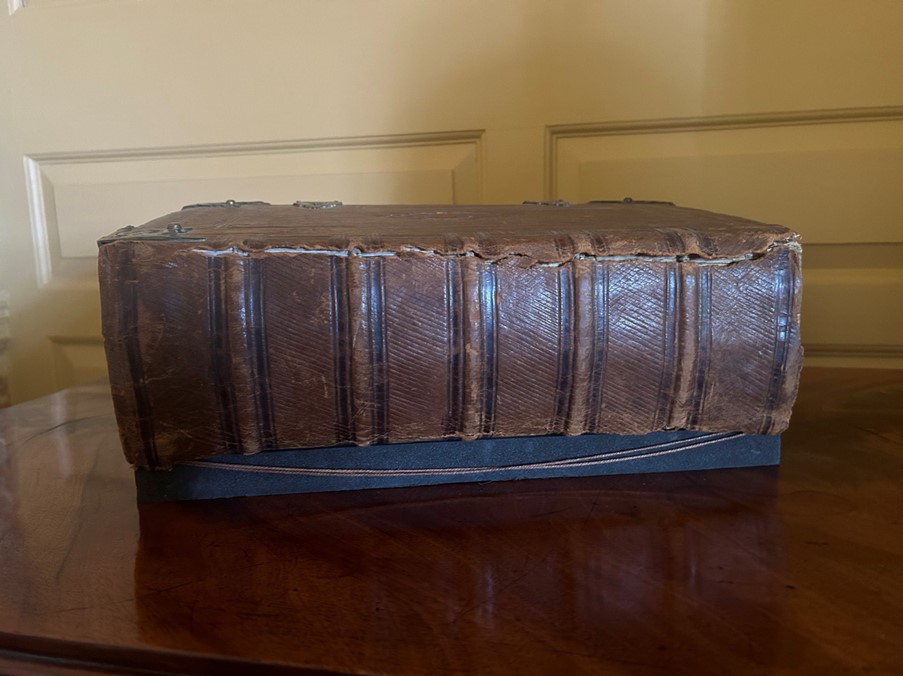
For the Schuyler family, their family Bible provided all these functions while still being a work of art indicative of their status. The Schuyler family Bible was printed in 1719, most likely by Pieter Keur, under the company of Pieter Rotterdam in Dordrecht (Dordt in English), one of the five largest cities in the Netherlands today. The outside binding of the book is made from leather decorated with ornate corner covers and clasps. Even with its elaborate decoration, the spine of the Bible is unfortunately in poor condition. In previous years the Bible was displayed all open causing much of the damage seen today.

The Bible is printed in the Statenvertaling, or “Staten General,” version of the Bible. This version of the Bible was specifically translated after the Synod of Dordrecht (1618/19) declared it necessary for a new edition of the Bible to be rendered in Dutch from the original Hebrew, Aramaic, and Greek languages to preserve the integrity of the translation into Dutch. The translation was meant to ensure that the original wording and manner of the text were uncorrupted, and often included brief explanatory and summary passages to assist with understanding. Generally, this translation is the Dutch equivalent of the King James Bible, which was commissioned by the Church of England in 1611 under the patronage of King James VI and I of England and Scotland for the same reason.

The Schuyler Family Bible
With this new translation into Dutch, the design layout was updated to reflect a style attractive to the people commissioning the Bibles. Like many illuminated manuscripts from the earlier Medieval period, the designs in these newer Bibles were intricate and often symbolic. For example, within the Schuylers’ family Bible, the title page is designed to look like a neoclassical temple with a banner hanging down from the entablature explaining the version and contents of the Bible, alongside its maker at the bottom. The columns are a close match for Roman Etruscan columns because of their signature rounded edges. There is also a large seal placed in front of the banner. This seal shows a raging lion—a common symbol for the seven provinces of the Netherlands—holding a sword raised in one paw with a sheaf of seven arrows in his other. These items and the choice of a lion are generally meant to symbolize strength and courage but, in this case, the lion and accoutrements most likely represent how the 7 Dutch provinces were taken back from the Holy Roman Empire at the beginning of the 17th century, creating unity within Dutch lands.

Around this symbolic lion is the phrase “eendracht maeckt macht,” which roughly translates to “unity creates power.” This form of the Bible itself is a work of unity as it was commissioned by a collective within the Protestant Church of the Netherlands to present more harmony within Biblical texts and teachings, while also unifying those in the Dutch world under the same version of the Bible. Many other symbolic items can be found throughout the design program of the “Staten General” Bible the Schuylers owned, but, beyond the interesting aspects of the Bible as a work of art, the Schuylers also used their it to record their family genealogy.

Genealogy in the Schuyler Family Bible 

The first entry into the genealogy pages records the marriage of Philip Schuyler’s (1733-1804) father Johannes Schuyler (1697-1741) and Cornelia van Cortlandt (1698-1762) on October 18th, 1723. The next entry announces the birth of Philip Schuyler’s older sister, Gertrude (1724-1813), who was born August 18th, 1724. Further down, it lists on November 20th, 1733, the birth of Philip Schuyler. Other family events such as the marriage of Philip Schuyler and Catharine van Rensselaer Schuyler (1734-1803) on September 7th of 1755, and the births of their many children, are listed in the Bible.

Within the bounds of the Schuyler family Bible, there are five children whose history exists only on those pages. These five children are the twins and triplets Catherine had in 1761 and 1770, respectively. We learned from the Bible record that one twin died at birth and was left unnamed, but the other was a girl who survived for about a month before passing away. Her name was Cornelia—a name that was later reused for another Schuyler daughter. The triplets were born in 1770, and were either stillborn or died shortly after birth. None were named and their sexes are not listed. The Schuylers do not write a lot about these twins and triplets, suggesting that the family may have wanted to recuse themselves from extended conversation about their losses. These children were not the first or last children the Schuylers would lose during childhood, but the loss may have felt much larger in these cases.    

The Schuylers’ family Bible provides us with a window not only into their religious world, but their familial one as well. While its present condition makes it to impossible to display open, the Bible is safely on display in the Yellow Parlor of Schuyler Mansion. We’re fortunate to have  research scans of the genealogy in particular, without which so much of the Schuylers’ history would be lost. 

The Schuyler Family Bible

The Schuyler Family Bible


Bibliography and Further Sources 

18th and 19th Century European and American Paper Binding Structures (culturalheritage.org)

De Hamel, Christopher. A History of Illuminated Manuscript (Phaidon, 1986)

History Between the Pages: The Family Bible in Genealogical Research (montgomeryhistory.org)

Israel, Jonathan (1995), The Dutch Republic: Its Rise, Greatness, and Fall 1477–1806, Clarendon Press, Oxford, ISBN 0-19-873072-1.

Israel, Jonathan. "The Statenvertaling Bible." Calvin University. Last modified 1995. Accessed September 18, 2024. https://calvin.edu/centers-institutes/meeter-center/about-the-synod-of-dordt/the-statenvertaling-bible.

Rudy, Kathryn M. (2016), Piety in Pieces: How Medieval Readers Customized their Manuscripts, Open Book Publishers, doi:10.11647/OBP.0094

Simms, P. Marion, PhD. The Bible in America: Versions That Have Played Their Part in the Making of the Republic. New York: Wilson-Crickson, 1936. https://hdl.handle.net/2027/mdp.39015026292543