Wednesday, November 16, 2016

An "Inside Look" at Schuyler's Chairs

by Danielle Funiciello

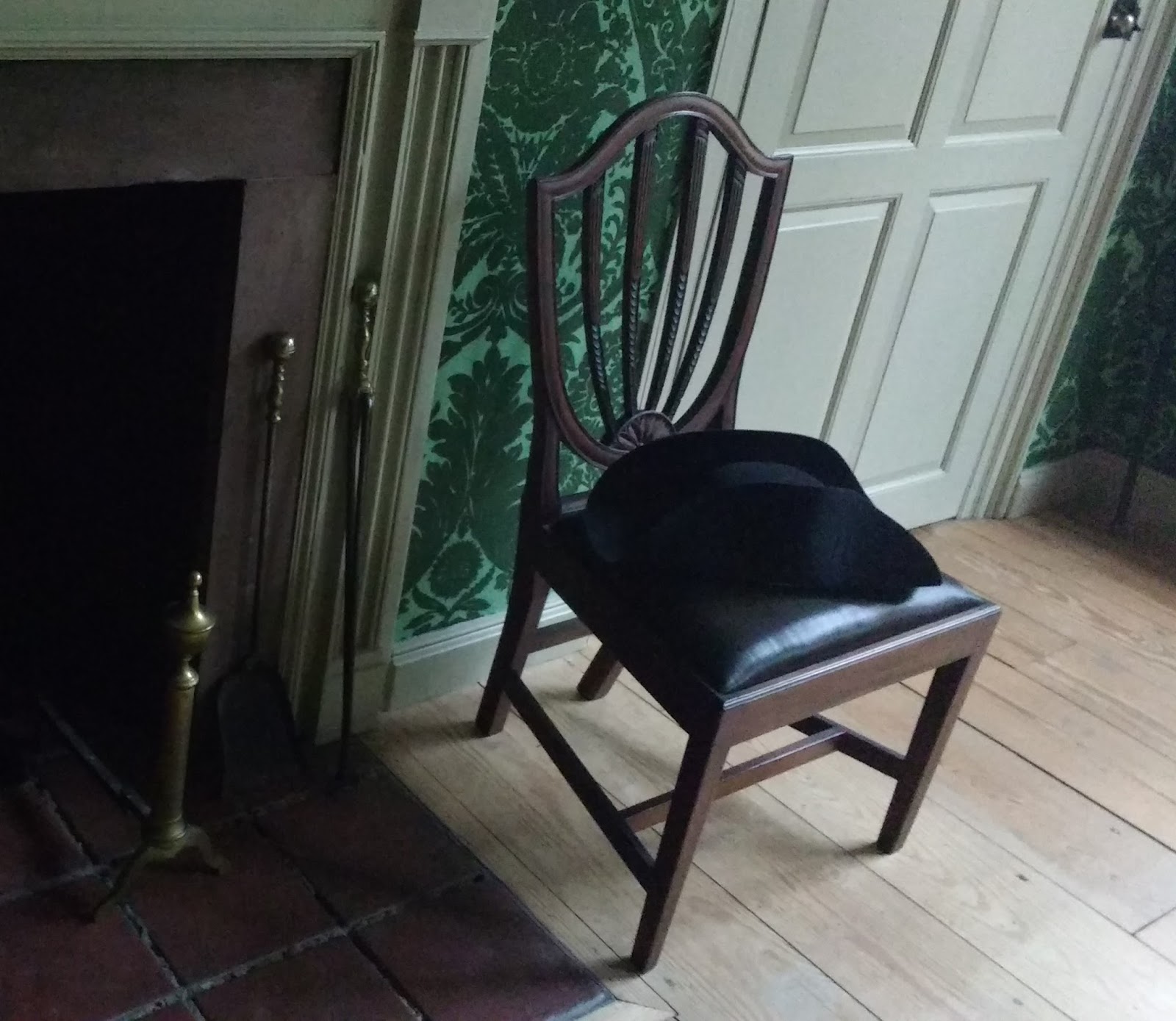
After being displayed in the home as part of the Art of Seating Exhibit PaSTport led by the Albany Institute of History and Art in conjunction with Partners for Albany Stories, our set of Heppelwhite shield-back chairs were once again removed from Schuyler Mansion this week. They make their way back to Peebles Island Resource Center to complete a restoration process that began over a year ago. In recent days, we were lucky enough to have the chairs displayed in a state of partial restoration, which allowed visitors to get an “inside look” at the chairs construction and on the work the Peebles Island team is doing.

             Taken apart, you can see that the chairs are filled with horse hair backed with a burlap material. The blue, floral, colonial-revival fabric currently on the chairs is incorrect for the period and will be replaced with a yellow silk that was woven in England to mimic a fabric swatch found in the arm of the chair (see our article on finding the outer fabric for the chairs here: http://schuylermansion.blogspot.com/2015/09/finding-fabric-for-schuylers.html?_sm_au_=iVV012Tr7qSnRN1Q). The outer fabric is lined with a layer of muslin and batting to contain the horse hair, protect the outer fabric and provide additional padding. In the close up images of the chair’s underpinnings, we can see that the burlap has been stitched in, and that the wooden base of the chair is riddled with tack holes from previous upholstery. When the chairs first returned to the home in the early 1900s, a period-incorrect blue satin had been on them, and one can imagine that these chairs have gone through a variety of colors over the course of more than 200 years.

             The deconstructed chair recently on display has not had wood treatments yet, but we can see from our second chair the intended wood quality. The wood of the chair is elm. The graceful design is embellished with painted leaf and flower designs which are likely original. When cleaning the wood, conservators are very careful to keep the delicate paint while still removing the dirtied varnish layers which create an incorrect patina for the 18th-century style. The painted designs are Greek and Roman motifs which became popular in Europe with the Neo-Classical style beginning in the 1750s and continuing into the works of later designers like George Heppelwhite (or, some historians argue, his wife Alice) who refined the style to feature the thin, sleek woodwork demonstrated so well in these Schuyler chairs. A book of his furniture designs was published in 1788 after George’s death, which exploded in popularity with woodworkers and consumers alike.

Philip Schuyler, always up on the latest fashions, certainly had the means and motivation to buy these chairs at the peak of their popularity.These chairs are such an important part of Schuyler Mansion’s collection not only because they date to the correct time frame (1790-1800) - matching with some of Philip Schuyler’s purchases and bequests - but parts of the set were donated to Schuyler Mansion by two separate branches of Schuyler descendants, making it very likely that these chairs trace back to Philip Schuyler. Given the high style of the chairs, we believe the chairs belonged in Schuyler’s city home, here in Albany, probably in the formal parlor where they now sit. We look forward to seeing these chairs returned to their former glory and hope that our visitors will too. They will return to the front parlor by the time we reopen in mid-May for our hundredth season!


Sunday, November 13, 2016

Stabilizing the Stairs

by Ian Mumpton

In 1765, when the Schuyler family’s mansion home was first completed, family and guests could have stood atop a gently sloping hill looking Eastwards across open pastureland all the way to the Hudson itself. Today, the mansion is surrounded by the historic South End community of the city of Albany. The house is still on raised ground, but the gradual slope of the hill has been replaced with a stone retaining wall, and the streets around the house have been cut much deeper. For a long time, from the 19th century onward, the mansion grounds were accessible from Clinton street via a stone staircase and gate kiddie-corner to the Howe library.

The Clinton street stairs at Schuyler Mansion
when it was an orphanage, circa 1905.
From the Albany Postcard Project
These stairs underwent many different forms over time. When the house was run as an orphanage by the St. Vincent’s Orphan Asylum Society under the supervision of the Daughters of Charity of St. Vincent de Paul, the appear to have run straight up from the street front, with an elaborate entrance surmounted by a cross. Later images show the stairs after the site had been opened as a museum, with the top portion of the solid stone wall replaced by an iron fence.


For many years, the stairs sat in a dilapidated condition, deteriorated to the point of being unsafe to use. As part of the restoration for the museum’s 100th anniversary, however, the old Clinton street stairs are being completely restored and will be open again for public use. In addition to restoring an important part of the historical property, it is hoped that this project will promote accessibility and further the relationship between the site and the community as, by this Spring, you will be able to walk out of your local library and right into history!
View of the restoration work being done on the stairs with the Howe Branch of the Albany Public Library across the street.


The Clinton street stairs aren’t the only stairs being restored at Schuyler Mansion. For over two hundred years, visitors have entered the house by climbing a set of brown sandstone stairs with iron railings into the hexagonal brick vestibule added to the home in about 1815. The earliest mention of these stairs comes from Philip Hooker’s evaluation of the home in 1818, created as an advertisement for his client, John Bryan, then the owner of the estate. According to Hooker, “Mr. Bryan has…added an hexagonal vestibule to the front, of singular beauty, with an elegant flight of stone steps & ornamental iron railing to the entrance.”

1818 image of Schuyler Mansion by Philip Hooker, showing vestibule and front stairs.
Original in the New-York Historical Society
Since then, thousands of feet and two hundred years’ worth of weather have worn the old stones to the point of needing serious restoration. Given the historical nature of the surviving stonework, this is a delicate process. The first step is disassembly. Currently each stone block in the staircase has been marked with a number so that they can eventually be returned to their exact original position. Next they will be removed, stabilized, and eventually reassembled to offer access to the home once more, hopefully for another two hundred years!

Schuyler Mansion is currently closed for the Winter, but special hours of availability are listed on our Facebook page as well as the Friends of Schuyler Mansion and the site’s NYS Parks pages. Get in touch to arrange a visit this Winter to see our restoration work in progress! 
Front Stair restoration at Schuyler Mansion.


Wednesday, November 9, 2016

Up On the Rooftop


by Danielle Funiciello

Visitors to Schuyler Mansion throughout November cannot help but notice the ongoing restoration work outside the mansion. If you were reading our blog last season, you know that Schuyler Mansion is working its way through a number of very exciting projects, gearing up for our 100th anniversary as a state historic site.
As our open season came to an end, with our regular tour schedule halting on October 30th, New York State Parks workers set up for some of the more significant projects to be completed by next year. Scaffolding has been set up on all four sides of the building and “what’s going on outside?” has become the first question from most visitors.
At the moment, “what’s going on” is the restoration of the double hip roof. The old roofing has been removed and new cedar shakes are being installed. The roof structure itself appears to be original to the house, though it has been re-shingled several times. The “List of real property belonging to Philip Schuyler” shows that the house was shingled in 1798, though the structure report prepared by New York State’s Division for Historic Preservation guesses that those shingles were white pine which was most common in Albany at the time as “such a roof is said to last forty years” according to 18th Century Albany visitor Peter Kalm. We are not sure which of the laborers that Philip Schuyler hired were responsible for the original shingling, but some of the hired carpenters included John Brown, Andrew Gautier, and Wert Banta, a freeman. John Brown may be the best guess, as Gautier seems to be a “joyner”, likely framing the house, and Wert Banta’s receipts show supplies and work related to the doors.
Once the roof is re-shingled, the homes’ balustrade - a Chinese style latticework - will be reinstalled. This latticework was removed at the beginning of the season for its own repairs and to be repainted. The balustrade for this home was almost certainly not part of the initial 1760s construction of the home, as no such architectural features have been dated before 1790 – that one at the historic home now known as the Morris-Jumel mansion then resided in by John Adams. It may have been added late in Schuyler’s lifetime, or perhaps by the first owner after the Schuyler family. Images from 1818 show the balustrade in place, though this was prepared by an architect who worked on the home and may have been a rendering of the house’s intended appearance. The importation of Chinese and other Asian styles was certainly underway during Schuyler's lifetime due to expanded trade with Asia, and this could have been a very fashionable addition to his very fashionable home.


The shingling is almost complete and we look forward to the many projects yet to come for Schuyler Mansion this next year. Stop by during one of our winter events or preregistered group tours – you can find information on our Facebook page – to see the works in progress. Stay tuned here on our blog for photos of the exciting work yet to come.

Thursday, November 3, 2016

A Place by the Fire

by Ian Mumpton

It’s getting colder here in Albany; time to stoke up the fire! In the 18th century, the Schuyler family used a variety of methods to keep warm throughout the long winter months. Brussels carpeting, foot warmers, woolen clothing, bed warmers, fire-screens, and many other objects would have been used to control the temperature of the home, but the primary source of heat came from wood-burning fireplaces in every chamber of the house.

The library fireplace with andirons, shovel, and tongs.
Today, the fireplaces of the restored home are furnished with andirons, fire shovels, and tongs. Most of these are period pieces, and some of the andirons are believed to be 19th century family pieces, descended from the children of Philip and Catharine Schuyler. One particularly fine example of a period shovel and tong set is on display in the library in the south west corner of the house. Made of iron with ball-headed brass handles, these tools were both decorative and practical. While it is unclear if they are original to the household, they date to approximately 1790, and are appropriate to the style Schuyler would have purchased.

Brass-handled shovel and tongs, circa 1790, maker unknown.
Family records specifically mention tools of this sort on several occasions. For example, in 1803, Philip Schuyler paid a total of fourteen shillings to a Peter Furlong for repairing a fire shovel , tongs, and a pair of andirons. In the same year, Furlong also altered iron curtain rods and hooks for the family. 
An image of an 18th century tavern fireplace with shovel and tongs.
Detail from "Tavern Interior", 1762, by John S.C. Schaak.


While curtains were reserved for decoration in the best rooms of the house, each chamber featured double-hung shutters on the windows. These shutters could be folded back into the walls to let in the maximum amount of daylight, but in colder months could be fully or partially closed as needed to keep in warmth. Furlong is also listed as having repaired a coffee mill for the family. Fire, curtains, and coffee? It sounds like Peter Furlong was the guy to have around during a long New York winter.


The regular tour season may be over at Schuyler Mansion, but our staff will be posting regular articles on a variety of topics over the coming months. Restoration efforts have redoubled as well, so check back often for images and articles on that topic, as well our other series. Lastly, while our regularly scheduled tours may be over until Spring, the site is offering tours by pre-registration on Thursdays and Saturdays over the Winter. Visit the Friends of Schuyler Mansion website or check us out on Facebook for details about tour times and other exciting events. 


Saturday, June 25, 2016

A Child Named Hanover

by Ian Mumpton 
 I Philip Schuyler of the City of Albany Esquire do hereby in pursuance of the act in such case made and provided, Certify that Since the fourth day of July last a negro male Child named Hanover was born to whose Service I am entitled now aged Eight months and fifteen Days dated this 15th Day of May 1801- From the Albany Manumission Register

In September of 1800, a baby boy was born to a woman named Silvia, one of the enslaved servants of the Schuyler family. It appears that Hanover was her third child; her others were named Tallyho and Tom. Because Silvia was herself enslaved, Schuyler claimed ownership of her children as well, including young Hanover. Silvia and her children would have worked for the Schuylers in the attached courtyard behind the mansion, and likely in the home as well.

It is unclear who Hanover’s father was. It is possible that he was one of the enslaved men at the Mansion - perhaps a man named Toby, purchased by Schuyler in 1797 at the same time as Silvia and her two older children. However, the father may have lived elsewhere, possibly as a freeman but more likely enslaved himself. The pattern of slavery in New York at the time involved a large number of people owning only a few slaves each. This led to the break-up of many families, with husbands and wives, parents, children and siblings being frequently sold away from each other. Nevertheless, some enslaved families found ways to stay in contact with their loved ones, and even (albeit infrequently) managed visits despite being separated by many miles in a society which severely restricted the mobility and independence of the enslaved. For instance, in 1774 a man named Mink stood as a baptismal sponsor for a child named Henry, along with a free woman of African descent named Sara Speck. Henry was the son of a man named Bill, an enslaved servant of a Schuyler relative, and Brit, a woman enslaved by Abraham Ten Broeck. Mink himself was enslaved by Philip Schuyler. Despite being enslaved by different families, these individuals were able to forge a wider kin-group amongst the enslaved and free population of Albany.

When Silvia was purchased by Philip Schuyler in 1797, she had little reason to think that she or any of her children would ever have the chance to escape from bondage. However, in 1799, New York State passed a Gradual Emancipation act which stipulated that any child born into slavery after July 4th of that year would be freed upon reaching the age of twenty eight for men, or twenty five for women. Until that age, they were still considered the legal property of the family who had enslaved them. While this did not affect Silvia, Tom, or Tallyho, it would have ensured the eventual freedom of the youngest child, little Hanover - albeit only after the Schuylers had claimed the labor of his early adult years. In accordance with the law, in May of 1801 Philip Schuyler legally certified that Hanover had been born after the 4th of July, 1799, but made certain to claim “[the] Service I am entitled”, referring to Hanover’s twenty eight year “indenture” as Schuyler’s legal property.

When studying the history of slavery, it is rare that we find “victories”. While it brought the prospect of freedom closer for many, the Gradual Manumission Act was still only a minor victory and, and like full abolition in New York in 1827, came too late for many. Occasionally though, it is possible to catch a glimpse of light in an otherwise discomforting past. One month after Philip Schuyler’s death, on December 15th of 1804, Philip’s two surviving sons, Philip Jeremiah and Rensselaer, as well as his sons-in-law John Church and Stephen Van Rensselaer, appeared before the mayor of Albany to officially, “manumit, remise, and forever set free” seven of the people enslaved by Philip Schuyler. Those named in the document include Silvia, Tom, Tallyho, and Hanover. Toby is not listed in the manumission record, and may have died or been sold away prior to this date. Silvia was approximately thirty years old when she gained her freedom. Hanover was just over four years old, the youngest of those freed. It is unclear what happened to this family after they gained their freedom, or to the three others manumitted in the same document; a woman named Phoebe, a man named Stephan, and a man named Tone, the oldest of the seven, who found freedom at the age of forty eight.

For further reading about the Gradual Manumission Act of 1799, click here or visit  your local library. Shane White’s, Somewhat More Independent: The End of Slavery in New York City, 1770–1810, is an excellent resource for anyone wanting to learn more about slavery and racial politics in late 18th/early 19th century New York City and New York State.


To learn more about the history of slavery and the enslaved at Schuyler Mansion, check out other articles in this series by clicking here, or visit the site Wednesdays through Sundays between 11:00am and 5:00pm to continue your exploration. Call us at (518)434-0834 for tour times!

Thursday, June 9, 2016

Welcome to the Northern Department


by Ian Mumpton

         Dear Sir
I do myself the Honor to inform Your Excellency of my Arrival at this Place early this Morning… Not one earthly thing for offence or defence has been done… About ten last night I arrived at the Landing place the north end of Lake George; a post occupied by a Captain and 100 men. A Centinel on being informed I was in the boat quitted his post to go and awake the guard, consisting of three men, in which he had no success. I walked up and came to another, a serjeant’s Guard. Here the centinel challenged, but suffered me to come up to him, the whole guard, like the first, in the soundest sleep. With a penknife only I could have cut off both guards, and then have set fire to the blockhouse, destroyed the stores, and starved the people here.


Major General Philip Schuyler, from a miniature by John Trumbull.
Philip Schuyler penned the above message to General Washington upon his first arrival at Fort Ticonderoga on July 18th, 1775, barely a month after being commissioned as a Major General in the Continental Army. What he found frustrated him, to say the least. Schuyler was already a man of military experience, having served as a provincial officer during the French and Indian War, and he expected high levels of professionalism from his men. Instead he found discipline lax, the department’s organization in shambles, the troops poorly equipped, ill, and underfed, and the general state of fortifications under his jurisdiction abysmal. He set out to rectify the situation, sending dozens of letters to other officers, military suppliers, and the Continental Congress. Elisha Phelps, the commissary at Albany, was ordered to send six grindstones to Ticonderoga, as well as nails and other building materials to put the garrison in order.

Embezzlement was another issue which Schuyler sought to address. Shortly after arriving at Ticonderoga, he issued a general order that, “All person whatever are strictly forbid from embezzling any of Colo. Skene’s Effects…at their peril.” Philip Skene was another former British officer, in this case a loyalist, whose nearby estate had been pillaged prior to Schuyler’s arrival. Schuyler similarly sought to end the embezzlement of supplies, ordering the commissaries to, “…pay great attention to the stores under their Care that they be not damaged by the weather  or other wise nor embezzled as a strict enquiry will be made from time to time by officers to inspect their proceedings.”

Schuyler also set an intelligence gathering network in place; identifying trustworthy and capable couriers tasked with conveying letters to Canada and returning with intelligence on the enemy.  Major Samuel Elmore at Crown Point was one of his subordinates charged with engaging “…a proper person to convey a Letter safely into Canada…[furthermore] any other intelligence You may receive from Canada You are immediately to communicate to me.”

Throughout all of this, Schuyler did not forget the underwhelming levels of discipline exhibited by the sentries who first greeted him at the Landing. Several of his orders specifically exhorted the troops of the Northern Army to show special diligence in their watch, including another letter to Elmore insisting that he, “… keep a small scout to the Westward lest any enemy should pass undiscovered and fall on our communication at the Landing or elsewhere- I have the fullest confidence that you will keep up strict discipline…”

Despite these early obstacles, Schuyler entertained an optimistic opinion of the troops under him, closing his report on the garrison by saying, “The officers and men are all good looking people, and decent in their deportment, and I really believe will make good soldiers as soon as I can get the better of this non-chalance of theirs. Bravery I believe they are far from wanting.”

You can read the original letter in its entirety here, through the National Archives.

This is the first of a series of posts focusing on Philip Schuyler’s military career during the American Revolution, so check back throughout the season for more Notes from the Northern Department!


Sunday, June 5, 2016

An Overview of Slave Trade in New Netherland, New York and Schuyler Mansion

by Danielle Funiciello

“Slaves? In New York?” - It’s not an uncommon question on tours of Schuyler Mansion. 

Actors portraying Schuyler's enslaved workers and freemen
during Schuyler Mansion's "The Accused" Focus Tour (2014)
We are often led to believe that slavery was, more or less, “a problem of the South”, when in fact, slavery was an integral and inseparable part of the Dutch, Colonial and Early-American economy throughout the New World. Drawing from census records, receipts and Schuyler letters, we can piece together that between 8 and 13 people were enslaved under Philip Schuyler at the Albany estate over the years. An additional population at Philip’s Saratoga estate brought the total to at least 30. In his writings, Philip Schuyler most often referred to his enslaved workers as “the servants”. We intend to bring some of these individual “servants” into the spotlight throughout the season here on our blog, but let’s begin with a more general history of Slavery in New York and Albany.

Slavery was a nearly immediate truth of New Netherland. The Dutch West India Company was granted access to the Americas and West Africa as part of the same charter in 1621. They began a fur trade in New Netherland and a slave trade mainly operating out of Angola. In the early years, slaves were brought over direct from Angola to build the infrastructure that allowed the fur trade to operate and paved the way for Dutch settlement.

By the 1650s, when Philip’s great-grandfather Philip Pieterse Schuyler was settled in New Netherland, the preference had shifted to importing enslaved people from the Dutch Caribbean rather than from Angola, because Africans who had already worked the sugar plantations were “broken-in” and thought easier to control.

This trend would carry forward as the English take control and rename the land New York in 1664. Under English Colonial rule, New Yorkers often opted to pay more for African, Native or mixed-race individuals who were already enslaved, since they had valuable skills sets and were already privy to the customary rules of their white owners.

By 1790, when the first census was taken, Albany held the highest slave count of any county in the state with 3,722 residents living in slavery – 572 just in the city of Albany itself, out of a total city population of 3,498. Schuyler claimed 13 enslaved persons on this census record. Even those households which did not own slaves were engaged in the trade in other ways. Boatmen trafficked human cargo upriver from NYC, bankers and lawyers brokered deals exchanging human property, citizens who could not afford slaves of their own rented their labor from their masters, and the products of farms and mills were traded downriver to New York and from there to sugar plantations in the Caribbean. This included produce from Schuyler’s mills in Saratoga.

Meanwhile, on Schuyler’s Albany estate, the enslaved population seems to have been made up of a handful of men, several women and their children. The farm land was largely worked by white tenant farmers, so the majority of enslaved men were engaged in moving materials between Schuyler’s properties, working with the animals, operating mills and other skilled and semi-skilled labor. Under Catherine Schuyler’s direction, enslaved women tended to household tasks such as cooking, washing, and perhaps helping tend to the children. Evidence suggests that enslaved children were trained to serve as wait staff within the home. Several enslaved people made attempts to escape from the Schuyler property over the years.

Manumission efforts in New York did not truly begin in New York until after the American Revolution. In 1788, the slave trade was banned in state, though loopholes could be found and slave owners kept title to those under their enslavement. In 1799, New York passed “An Act for the Gradual Abolition of Slavery” which allowed for the manumission of slaves dependent on their age and date of birth. In 1827, slavery was outlawed entirely, but even under these laws many slave owners were able to transfer their enslavement into indentured servitude or otherwise devise unfair working conditions for “freemen”. Slavery may have functioned differently in the North, but it was the economic base on which New York and Albany were built.


We intend to discuss all aspects of life at Schuyler Mansion for the enslaved population in greater detail moving forward, but we hope this article gives you a framework for understanding the world in which Philip Schuyler and his enslaved population lived and worked.

Sources (in addition to the collections at Schuyler Mansion) and further reading: